
Waterfront living makes outdoor spaces an important part of a home. Gardens, terraces, pools and entertaining areas may all rely on electrical lighting, outlets and equipment.
But a waterfront address is also a reason to think carefully about exposure, maintenance and emergency access. Rain, water entry, damaged outdoor fittings and older electrical infrastructure need attention, not assumptions that an installation is safe because it still works.
For Woolwich homeowners, the priority is prevention: choose equipment suited to its location, confirm appropriate circuit protection, maintain the installation and know when to keep clear.
Russo Electrical provides repairs, switchboard upgrades, safety inspections and 24/7 emergency electrical services in Woolwich, Hunters Hill and Huntleys Point. Its local guidance highlights older wiring, household capacity, private electrical infrastructure and trees near overhead lines as matters worth assessing.
This guide explains practical precautions for waterfront properties without assuming that every home faces the same conditions or needs the same upgrades.
1. Assess the Property’s Actual Exposure
Not every waterfront home has the same electrical risks.
A sheltered courtyard, an exposed garden, a lower-level equipment area and an elevated terrace can present different conditions. The useful question is not simply whether the property is near the water, but how its electrical equipment is installed and exposed.
When discussing an assessment, identify:
Russo Electrical recommends assessing wiring, switchboards, earthing, safety switches and capacity for modern equipment in Woolwich homes. It also identifies private poles and overhead service cables as matters requiring an appropriately qualified contractor.
Do not assume every waterfront property needs “marine-grade” equipment
Ask the electrician and product supplier what is suitable for the actual location and exposure. A broad marketing description is not a substitute for installation instructions and a properly specified product.
The assessment should explain why the selected fittings suit the conditions rather than treating every waterfront address identically.
2. Use Outdoor Fittings Intended for the Location
An indoor fitting does not become appropriate outside simply because it sits beneath an awning.
Outdoor electrical guidance recommends weatherproof power points and switches where exposure to the elements is likely. It also advises using power boards rated for outdoor use and protecting them from rain and sprinkler splash.
For each proposed fitting, discuss:
Understand IP ratings
Ingress protection, or IP, ratings describe protection against solids and water.
For example:
| Rating | General protection described |
|---|---|
| IP44 | Objects larger than 1 mm and splashing water |
| IP65 | Dust-tight protection and resistance to water jets |
| IP67 | Dust-tight protection and temporary immersion under specified conditions |
These categories are not interchangeable. IP65 does not establish suitability for submersion, and IP67 is not automatic approval for permanent underwater use.
The appropriate rating depends on the application. Do not select a fitting using the number alone.
3. Protect Connections as Well as Outlets
A suitable wall outlet does not make every connected item suitable for outdoor exposure.
The appliance, plug, lead, power board and any connector all need consideration. Energex warns against exposing extension-lead joins to weather and recommends equipment suited to outdoor use.
Avoid improvised weatherproofing
Do not assume plastic bags, tape or household containers provide an appropriate connection arrangement.
Ask the supplier or electrician about purpose-designed protection and follow its instructions.
Pay particular attention to equipment that remains connected for long periods. Confirm that the complete arrangement is suitable when the plug is inserted, not just when the outlet cover is closed and unused.
Keep portable equipment away from water
Australian government guidance warns against using portable appliances, tools or extension leads in water or rain.
Outdoor suitability still has limits. Follow the product’s operating instructions rather than assuming weather resistance makes wet use acceptable.
Related Woolwich project: Pendant and Basement Lighting
In a documented Woolwich project, Russo Electrical installed new lighting and power points in a sandstone basement, including weatherproof power points with surface conduit. This is an example of completed work, not a claim that every waterfront property requires the same fittings.
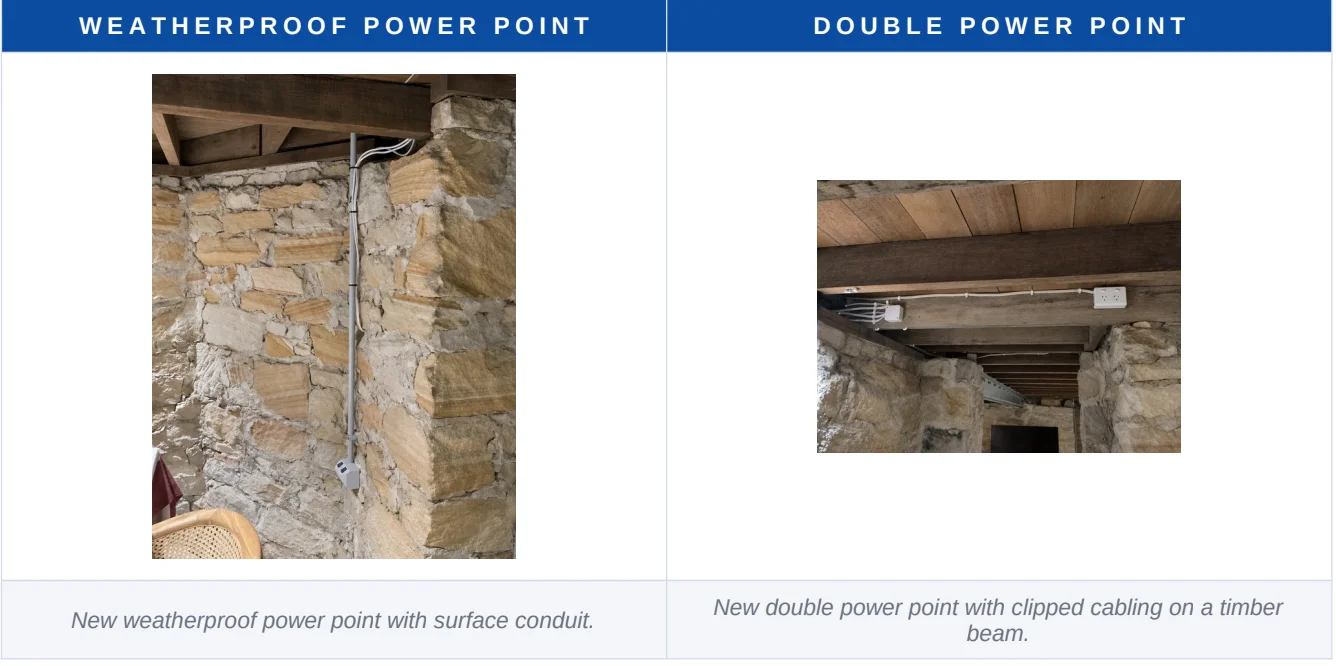 Completed Woolwich projectPendant and Basement Lighting in WoolwichWeatherproof and double power points, surface conduit, and new lighting installed in a sandstone basement.View project →
4. Confirm Safety-Switch Coverage
Safety switches, also called residual current devices or RCDs, help protect people from severe electric shock. They detect current leakage and disconnect power rapidly.
Outdoor equipment should be supplied through appropriate safety-switch protection. Electrical Safety Office guidance recommends using a safety-switch-protected circuit for outdoor equipment.
Circuit breakers are different
NSW Government guidance explains that:
A safety switch helps protect people from severe electric shock.
A circuit breaker protects circuitry and wiring.
Some devices combine these functions. A safety switch has a “T” or “Test” button, but ask an electrician if you are unsure what protection is present.
One device may not protect every circuit
Older homes may have a single safety switch protecting several circuits. A device only protects the circuits connected through it.
NSW recommends asking a licensed electrician whether the home has the appropriate number of safety switches.
When arranging outdoor work, ask specifically which circuits supply the equipment and how they are protected.
5. Test Safety Switches Twice a Year
NSW recommends testing household safety switches every six months.
For safely accessible devices, follow the manufacturer’s instructions and government guidance. Notify everyone in the home because the relevant circuits should lose power during testing.
Contact a licensed electrician if:
6. Take Wet-Weather Tripping Seriously
If power cuts out during rain, record the pattern and seek advice. Do not assume a particular garden light, outlet or appliance is responsible without testing.
Useful details include:
Do not approach a wet switchboard
Ausgrid warns not to approach the main switchboard in wet weather or where the property is already flooded. Metal enclosures can be particularly dangerous in flood conditions.
Keep clear and call for professional assistance.
Do not step through water or reach across wet equipment to attempt isolation.
7. Arrange Inspection Before Reusing Flood-Affected Equipment
Floodwater can affect more than the visible exterior of electrical equipment.
Ausgrid states that flood-damaged properties need checking by a qualified electrical professional before power is switched back on. It specifically identifies equipment close to ground level, such as air-conditioning units and pool pumps, as potentially affected.
Dry-looking does not mean inspected
Do not assume an appliance or fitting is safe because the surrounding water has receded or its exterior appears dry.
Follow professional advice before reconnecting or operating affected equipment.
Move equipment before water arrives, only if safe
Ausgrid advises relocating portable appliances away from areas likely to be affected by water where it is safe to do so. If a property is already flooded, do not approach electrical equipment to retrieve it.
A preparedness plan should be made in advance, not improvised while water is entering.
8. Give Pools and Water Features Separate Attention
Pool equipment, pumps and lighting need their own installation assessment.
Do not assume that equipment appropriate for an ordinary garden location can be placed anywhere near a pool or water feature.
For proposed work, provide the electrician with the equipment specifications and intended location. Ask what installation requirements apply rather than relying on a generic distance or product label.
If pool equipment has been affected by flooding, Ausgrid advises that it should not be switched back on until professionally inspected.
Similarly, a temporarily immersion-rated light is not automatically suitable for permanent underwater use.
9. Check Older Wiring and Switchboards
A waterfront location does not make every electrical concern moisture-related.
Older wiring, inadequate protection and insufficient capacity may require attention independently of the property’s exposure.
NSW recommends considering inspection of homes built before the 1980s for aged or faulty wiring. It warns that older rubber insulation can deteriorate and crumble, potentially exposing conductors.
Age is a reason to investigate, not a diagnosis
An older home may have been extensively upgraded. Another may contain a mixture of old and new electrical work.
Ask for an assessment of the current installation rather than assuming the whole home needs rewiring.
Russo Electrical identifies switchboard upgrades as a frequently requested Woolwich service, particularly where older homes need safety-switch or capacity improvements.
10. Plan Capacity Before Adding Major Equipment
Waterfront homes may have outdoor equipment alongside the usual household appliances. The requirements should be assessed as a complete installation rather than one purchase at a time.
Before adding major equipment, provide specifications for items such as:
Do not assume spare spaces in a switchboard establish adequate electrical capacity. Ask the electrician to explain what the assessment confirms and what work is necessary.
11. Include Private Poles and Overhead Lines in Maintenance Planning
Some properties have private electrical infrastructure beyond the network connection point.
Russo Electrical’s Woolwich guidance notes that property owners are generally responsible for maintaining private poles, powerlines and associated equipment beyond that point. The exact assets and responsibilities should be confirmed for the property.
Arrange inspection by an appropriately qualified contractor where required. Do not assume an ordinary internal electrical repair appointment includes private-pole or supply-side work.
Never clear branches from powerlines yourself
Trees or branches contacting powerlines can become dangerous.
Ausgrid warns that fallen trees across wires may be live and must not be moved by homeowners. Stay at least eight metres away from fallen lines and report hazards to Ausgrid on 13 13 88. Call 000 for an immediate threat to life.
Do not approach a line because it appears insulated, quiet or disconnected.
12. Remember That Solar Can Remain Live During an Outage
Turning off mains power does not necessarily make a solar installation safe.
NSW warns that solar panels and their cables can continue generating electricity in daylight after the mains supply has been disconnected. Treat them as live sources of electricity.
The guidance also says:
Do not operate solar components covered in water or still wet.
Do not reconnect the system if the roof has been damaged.
Do not assume a storm- or flood-affected system is safe.
Know the shutdown procedure supplied by the installer, but do not approach wet or damaged components to carry it out.
13. Use Licensed Professionals for Fixed Electrical Work
Outdoor power points, fixed lighting and wiring are not DIY projects.
NSW prohibits unqualified people from wiring a property, replacing power points, moving lights and switches, or undertaking fixed electrical maintenance. DIY work can cause injury, death or fire and affect insurance.
Before agreeing to work:
Waterfront Electrical Safety Checklist
| Area | What to review |
|---|---|
| Outdoor fittings | Suitability for the actual exposure |
| Plug connections | Protected according to product requirements |
| Safety switches | Appropriate coverage and six-monthly testing |
| Older wiring | Assessment where history or condition is uncertain |
| Switchboard | Condition, protection and capacity |
| Pool equipment | Installation requirements and post-flood inspection |
| Private infrastructure | Responsibilities and specialist inspection |
| Trees and lines | Professional management; no DIY clearing |
| Solar | Shutdown knowledge and caution around wet components |
| Records | Invoices, findings, manuals and compliance documents |
Use the checklist to organise an enquiry, not to declare the installation safe.
How Russo Electrical Can Help Woolwich Homeowners
For assistance with residential repairs and safety assessments, visit our Woolwich electrician page or explore switchboard upgrades.
Russo Electrical advertises residential repairs, safety inspections, switchboard upgrades, maintenance and 24/7 emergency support in Woolwich, Hunters Hill and Huntleys Point.
When booking, provide:
Ask whether the job requires routine inspection, fault finding or a specialist service. Confirm current availability, call-out fees, diagnostic charges and any separate repair quotation.
Call 0485 009 500 to discuss the work. Advertised emergency availability does not establish a guaranteed arrival time, so confirm attendance directly.
Frequently Asked Questions
Does every waterfront home need special electrical equipment?
Equipment should be selected for its actual location, exposure and intended use. Ask the electrician and supplier to confirm suitability rather than relying on a broad label.
Are weatherproof fittings safe in floodwater?
Do not assume so. Water-protection ratings have limits, and flood-affected equipment requires professional assessment before reuse.
Should I turn off the main switch if the property is flooded?
Do not approach a switchboard in flooded or unsafe wet conditions. Ausgrid recommends keeping clear and seeking professional assistance.
How often should safety switches be tested?
NSW recommends every six months. Contact an electrician if testing fails or a switch does not reset.
Can I move a branch touching a powerline?
No. Keep clear. Ausgrid warns that trees contacting lines may be live. Stay at least eight metres from fallen lines and call 13 13 88.
Is solar safe once mains power is disconnected?
Not necessarily. Panels and cables can remain live in daylight. Do not approach wet or damaged solar components.
Plan for the Conditions Before a Fault Occurs
Good waterfront electrical safety combines appropriate equipment, suitable protection, maintenance and a clear emergency plan.
Assess the actual exposure, report recurring faults and do not reuse flood-affected equipment without professional advice. Keep well clear of fallen lines, wet switchboards and damaged solar components.
For Woolwich homeowners, Russo Electrical provides local assessment, repairs and upgrade services. A clear description of the property and its electrical concerns helps establish the right scope before work begins.
Waterfront Electrical Safety Resources
NSW Government: Electrical safety in the home
Ausgrid: Powerline and flood safety information
Explore our Woolwich electrician services, switchboard upgrades and completed case studies.