
Replacing a pendant light can transform a room. An outdated fitting above the dining table can become a statement piece, a dark kitchen island can gain practical task lighting, and a bedroom can feel more welcoming with a better-positioned light.
But there is an important distinction between choosing a new pendant and installing it.
In NSW, replacing a hardwired pendant light is electrical installation work and must be carried out by a licensed electrician. NSW Government guidance specifically warns unqualified homeowners not to install, replace or move lights and switches. Changing a light globe is different from replacing the fitting connected to the ceiling wiring.
So, how do you replace a pendant light safely? As a homeowner, your role is to choose a suitable fitting, confirm the installation requirements, organise a licensed electrician and prepare the space. The electrician handles isolation, removal, connection and testing.
Russo Electrical provides indoor and outdoor lighting services across Sydney’s Inner West, Lower North Shore and Eastern Suburbs, including new lighting, replacements, feature lighting and controls.
This guide explains what to consider before buying a pendant, how professional replacement works and what can affect the scope and cost.
Can You Replace a Pendant Light Yourself?
If the pendant is hardwired into your home’s electrical installation, do not replace it yourself unless you hold the appropriate electrical qualification and licence.
Even a like-for-like replacement can involve electrical connections, earthing, safe isolation and testing. Switching the light off at the wall is not a substitute for the electrician’s isolation and verification procedures.
NSW Government guidance states that DIY electrical work is dangerous and illegal. It can expose occupants to injury or death, cause fire and affect insurance.
Changing a globe is not the same as changing the light
These tasks are different:
| Task | What it involves |
|---|---|
| Changing a replaceable globe | Removing and replacing the lamp intended for user replacement |
| Replacing a pendant fitting | Removing the light connected to the fixed electrical installation and installing another |
| Relocating a pendant | Moving the lighting point and potentially altering wiring and ceiling supports |
| Installing several pendants | Adding or modifying lighting points, wiring and controls |
NSW guidance permits ordinary globe replacement but warns unqualified people not to install, replace or move lights and switches.
If you only want to change a removable decorative shade, follow the manufacturer’s instructions and confirm whether that can be done without disturbing electrical components. If you are unsure, have the electrician assess it.
Why Homeowners Replace Pendant Lights
A pendant replacement may be part of a renovation, a decorative update or a response to a faulty fitting.
Common project goals include:
Not every replacement needs extensive electrical work. However, the scope changes when the new fitting is heavier, the position moves, the existing wiring needs repair or the controls are unsuitable.
Russo Electrical’s lighting service covers replacements, new lighting, feature lighting, controls and practical upgrades for indoor and outdoor areas.
Step 1: Decide What You Want the New Pendant to Do
Before comparing finishes and shapes, decide what the light needs to achieve.
A pendant above a kitchen island has a different job from one used mainly as a decorative feature in a hallway. A dining pendant may need to illuminate the table comfortably without dominating the room.
Useful planning questions include:
Treat these as a design brief for the supplier and electrician. Product specifications and the room layout should guide the final choice rather than appearance alone.
Step 2: Check the Existing Location
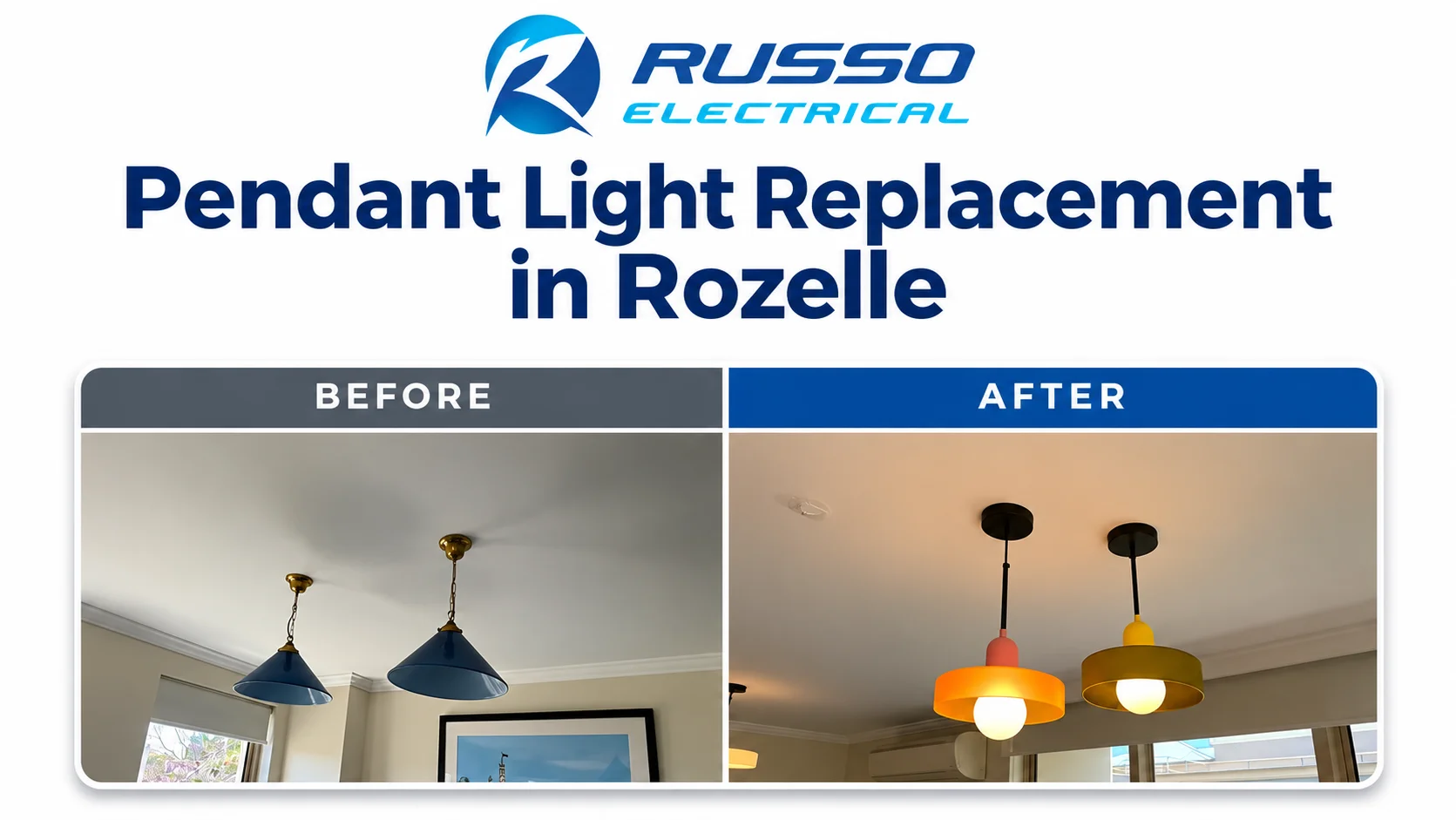 Related case studyPendant Light Replacement in RozelleSeven client-supplied pendants installed, including new coloured pendant lights.View the project →
A like-for-like replacement generally means installing a new pendant at the existing lighting point. Moving it is a different project.
Before requesting a quote, note:
If you are changing the layout, tell the electrician before booking. Russo Electrical’s enquiry process asks for job details, the suburb and useful photos, followed by an assessment and an inspection where required.
Replacing versus relocating
Moving a pendant may involve more than extending its cord. The electrician needs to assess the wiring route, mounting arrangement and condition of the existing installation.
There may also be a hole or visible mark at the old location. Ask whether ceiling repairs and painting are included or need to be organised separately.
Avoid assuming that an electrical quote includes every decorative repair. Confirm the boundaries of the job in writing.
Step 3: Choose a Fitting Suitable for the Space
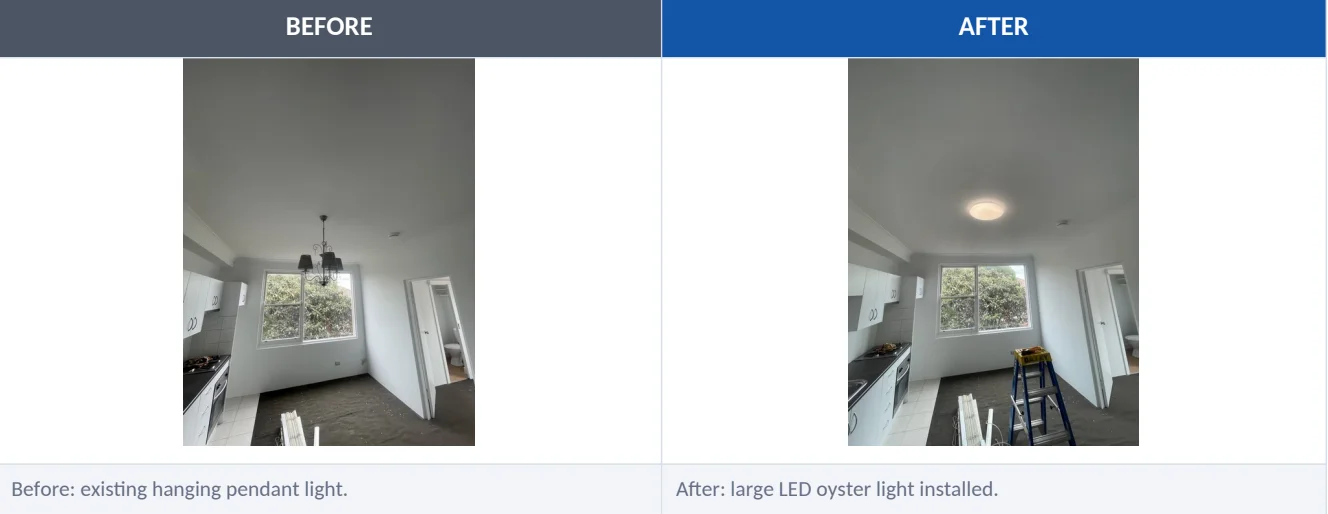 Related case studyPendant to LED Oyster Light in LeichhardtSee how a hanging pendant was replaced with a compact ceiling-mounted LED oyster light.View the project →
The product listing should provide more than a photograph. Before buying, collect the installation instructions and technical details for the electrician to review.
Useful information includes:
Consider the weight
A larger pendant or chandelier may need a different support arrangement from the fitting it replaces.
Do not assume the existing ceiling attachment is suitable simply because it supported the old light. Ask the electrician to assess the new fitting’s weight and mounting instructions before the installation date.
Consider the ceiling canopy
The canopy is the cover where the pendant meets the ceiling.
A smaller canopy may reveal marks left by the old fitting. A different mounting arrangement may also require adjustments. Discuss this early if the ceiling has recently been painted or has decorative features you want to preserve.
Consider the location
A fitting intended for an ordinary indoor room should not automatically be assumed suitable for a bathroom, exposed outdoor area or location affected by moisture.
Ask the electrician to confirm that the proposed product and installation position are appropriate. Product appearance is not evidence of electrical suitability.
Step 4: Confirm Globe, LED and Dimmer Compatibility
A pendant replacement is a useful time to review how the light will be controlled.
Do not assume that an existing dimmer will work with every new fitting or LED globe. Before purchasing, ask the supplier for the manufacturer’s compatibility information and have the electrician review it.
If the current light flickers, make that part of the booking. Russo Electrical offers fault finding for flickering lights as well as lighting replacements and controls.
Replaceable globes or integrated LEDs?
Ask yourself what maintenance arrangement you prefer.
For a fitting with replaceable globes, check the required globe type and the manufacturer’s limits. For an integrated LED pendant, ask what happens if the LED module or driver fails and what warranty support is available.
These questions are best resolved before buying, particularly for fittings that will be difficult to access later.
Discuss the desired light effect
For a more useful conversation with the supplier, describe the effect you want rather than asking only for a “bright” or “warm” light.
For example:
Step 5: Arrange a Licensed Electrician
Before agreeing to the work, check the electrician’s current licence.
NSW Government guidance recommends checking licence details on the public register and using a licensed electrician for electrical installation work.
When requesting a quote, provide:
What Happens During Professional Pendant Replacement?
The following is an overview of the electrician’s work, not a DIY wiring guide.
Assessment of the fitting and installation
The electrician checks the proposed fitting, existing installation, mounting requirements and any reported faults.
If the job differs from the original description, the scope may need to be clarified before proceeding.
Safe electrical isolation
The relevant supply is isolated and verified using professional procedures.
Homeowners should not attempt to prepare the wiring or loosen the old fitting beforehand. NSW warns against unqualified installation, replacement or movement of lighting equipment.
Removal and inspection
The old fitting is removed so the electrician can assess the accessible connections and installation condition.
If damaged or deteriorated wiring is discovered, further work may be needed. NSW specifically cautions that older rubber-insulated wiring can deteriorate and crumble, potentially exposing conductors.
Installation and adjustment
The new fitting is mounted and connected according to the applicable requirements and manufacturer’s instructions. The suspension length and alignment are set as part of the agreed installation.
Testing and handover
The completed work is tested, the operation is checked and required documentation is provided.
NSW states that electrical installation work must be tested and accompanied by a uniquely numbered Certificate of Compliance for Electrical Work.
Russo Electrical’s published process similarly includes completion of the agreed work, testing and provision of the required documentation.
What If the Electrician Finds Old Wiring?
Replacing a pendant can reveal issues that were hidden behind the old canopy.
This does not automatically mean your whole home needs rewiring. It means the condition found needs assessment before the new fitting is installed.
NSW recommends considering an electrical inspection for homes built before the 1980s because aged or faulty wiring may be present. The government warns that old rubber insulation can deteriorate and leave wiring exposed.
If additional work is recommended, ask:
How Much Does It Cost to Replace a Pendant Light?
There is no single price that reliably covers every pendant replacement.
A straightforward replacement at an accessible existing lighting point is a different job from relocating several heavy fittings above a staircase or kitchen island.
Ask for a quote based on the actual installation rather than relying on a generic online figure.
Factors to discuss include:
| Project detail | Why it matters to the quote |
|---|---|
| Number of pendants | Determines the overall scope |
| Existing versus new position | Relocation may require wiring alterations |
| Ceiling height | Affects access arrangements |
| Fitting weight and mounting | May require additional support assessment |
| Wiring condition | Repairs may be necessary before installation |
| Dimmer requirements | Controls may need replacement or modification |
| Ceiling finish | Patching and painting may be separate |
| Removal of the old fitting | Disposal should be confirmed |
Ask whether the quote includes installation, testing, documentation and removal of packaging or old equipment. Also confirm how unexpected defects would be quoted.
Russo Electrical invites homeowners to send job details and photos so the work can be assessed before the scope is explained.
How to Prepare Your Home for Installation
Your preparation should make access easier without disturbing electrical equipment.
Before the appointment:
If the pendant is above a dining table or island, be ready to discuss the finished height and sightlines. The final arrangement should suit the fitting, room and people using it.
What If You Rent or Live in an Apartment?
Before arranging a decorative replacement, confirm the necessary approval with the landlord or property manager. For an apartment, also ask whether the proposed work affects common property or requires building-access arrangements.
Report an electrical fault separately from a style preference.
NSW advises tenants to notify the landlord or agent promptly about electrical faults, which it describes as urgent repairs.
Do not replace a hardwired pendant yourself because it is inside your individual apartment. The licensing requirements still apply.
Common Pendant Replacement Mistakes to Avoid
Buying before checking the specifications
A product photograph will not tell you whether the fitting has the right suspension range, mounting requirements or controls.
Obtain the specifications first and send them with your enquiry.
Assuming like-for-like means DIY
Using the existing lighting point does not turn hardwired replacement into a homeowner maintenance task. NSW specifically includes replacing lights among the work unqualified people should not undertake.
Ignoring an existing fault
If the current fitting flickers, trips a protective device or has visible damage, disclose that before booking. The job may require fault finding as well as replacement. Russo Electrical offers both services.
Leaving height and alignment until the last moment
Discuss the intended location and suspension before installation, particularly where furniture or cabinetry determines the centre point.
Assuming all repairs are included
Clarify responsibility for ceiling patching, painting, disposal and any wiring defects discovered during the work.
How Russo Electrical Can Help
Russo Electrical provides new lighting, replacements, garden lighting, feature lighting and controls across Sydney’s Inner West, Lower North Shore and Eastern Suburbs. It also offers fault finding where lights flicker or other electrical issues need testing.
For a pendant replacement, send the team a description of the project, your suburb, photos of the existing fitting and the new pendant’s specifications.
The company’s stated process is to assess the information, arrange an inspection when required, explain the recommended scope, and complete and test the agreed work.
That approach allows the installation requirements to be considered before the old fitting comes down.
Frequently Asked Questions
Can I replace a pendant light myself in NSW?
Not if it involves replacing a hardwired fitting and you are not appropriately qualified and licensed. NSW guidance warns unqualified people not to install, replace or move lights and switches.
Can I change the globe myself?
Ordinary globe replacement is different from replacing the fitting. Follow the fitting’s instructions, use the correct globe and seek help if the equipment is damaged or difficult to access. NSW distinguishes globe changing from electrical installation work.
Can the new pendant use the existing lighting point?
Possibly. The electrician needs to check the fitting, mounting arrangement and existing installation before confirming the scope.
Can I move a pendant so it sits over the centre of my table?
Yes, this can be discussed as part of a lighting alteration, but it may require more work than replacing the fitting in its existing position. Have an electrician assess the new location rather than attempting the wiring change yourself.
Will my existing dimmer work?
Do not assume so. Provide the fitting and globe specifications, along with any manufacturer compatibility information, so the electrician can review the controls.
Will I receive compliance documentation?
NSW requires electrical installation work to be tested and a uniquely numbered Certificate of Compliance for Electrical Work provided. Confirm the documentation with your contractor.
Replace the Pendant, Not Your Peace of Mind
The safest way to replace a hardwired pendant light is to choose a suitable fitting and have a licensed electrician install and test it.
Your contribution is the planning: deciding what the light should achieve, collecting product details, confirming the location and preparing access. Leave the electrical disconnection, connection and testing to the professional.
For Sydney homeowners, Russo Electrical offers pendant-relevant lighting replacements, feature lighting and controls, with assessment, testing and documentation included in its published service process.
Official electrical safety information
NSW Government: Electrical safety in the home
NSW Government: Electrical licensing
NSW Government: Certificate of Compliance for Electrical Work