
Outdoor sensor lighting can improve convenience and visibility around a Waverton home, but it works best when it is planned around the property’s actual layout, exposure and intended use. A sensor light is not automatically the right answer for every entrance, garden path or driveway.
The key is planning: decide where light is needed, choose a fitting suited to the location, confirm the circuit and protection and arrange installation by a licensed electrician. A faulty sensor light may need replacement, but the wiring, connection and circuit protection still need consideration before the job is complete.
Russo Electrical provides outdoor lighting, electrical repairs and fault finding and 24/7 emergency services in Waverton, Wollstonecraft and Crows Nest. Its local service includes lighting installations, repairs and switchboard upgrades.
This guide explains how to plan outdoor sensor lighting safely, what to check before installation and when to seek professional help.
1. Start With the Areas That Need Lighting
The best sensor lighting plan depends on how the property is used.
A front entrance, side passage, driveway, garden path and rear yard can each have different requirements.
What to consider
These questions help establish the scope. They do not replace professional inspection.
Do not assume every area needs the same lighting
A front entrance may need a sensor light for convenience. A side passage may need a sensor light for safety. A garden path may need low-level lighting.
The assessment should explain why the selected fittings suit the location rather than treating every area identically.
2. Consider Sensor Operation and Manual Override
Sensor lights can operate automatically when movement is detected, but some homeowners prefer the option to override the sensor manually.
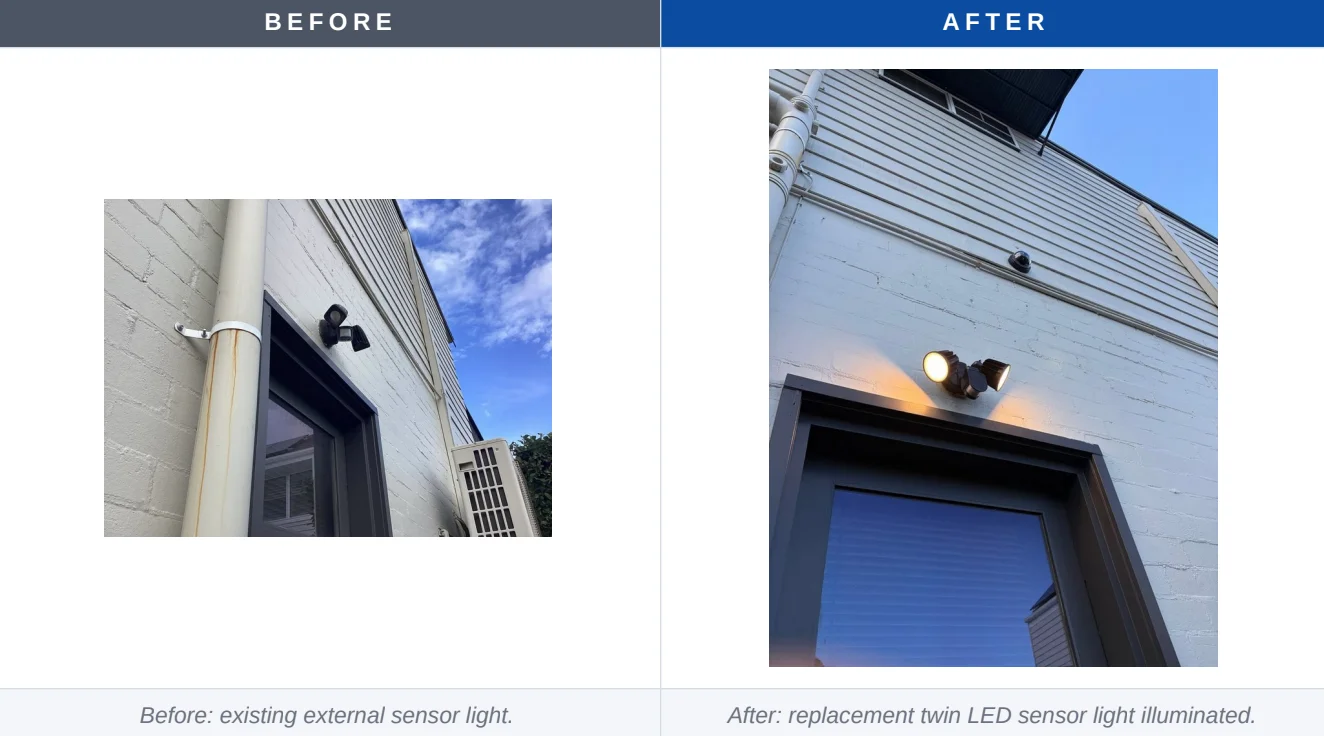
Russo Electrical’s Five Dock case study involved replacing a faulty rear side-passage light with a black twin LED sensor light offering sensor operation and manual override.
Why manual override can be useful
What to ask before choosing
Ask the electrician:
Do not assume that every sensor light offers the same features.
3. Consider LED Options for Outdoor Lighting
LED fittings are a common choice for outdoor sensor lighting.
Russo Electrical’s Five Dock case study involved replacing a faulty rear side-passage light with a black twin LED sensor light.
Why LED lights are popular
What to check before choosing
Ask the electrician:
Do not assume that a new fitting will resolve a fault in the wiring supplying it.
4. Consider Weatherproof Fittings for Exposed Areas
Outdoor fittings need to remain weatherproof over time.
Russo Electrical’s outdoor electrical guidance identifies fittings that are no longer weatherproof as a matter requiring assessment.
What to look for
Do not attempt to reseal a fitting with tape or household materials.
Ask the electrician to assess whether the fitting can be repaired or whether replacement is appropriate.
Does an old fitting automatically need replacement?
Not automatically.
The condition of the fitting, its exposure and the results of testing determine the appropriate response.
Russo Electrical’s outdoor lighting guidance identifies ageing or failing fittings as a matter requiring assessment, not an automatic replacement.
5. Understand IP Ratings for Outdoor Fittings
Many outdoor electrical products display an ingress protection, or IP, rating.
The first digit describes protection against solids and dust. The second describes protection against water. These ratings distinguish different types of exposure rather than giving a blanket promise that water cannot cause damage.
What the ratings mean
| Rating | General protection described | Important limitation |
|---|---|---|
| IP44 | Objects larger than 1 mm and water splashes | Not an immersion rating |
| IP65 | Dust-tight protection and resistance to water jets | Does not establish suitability for submersion |
| IP67 | Dust-tight protection and temporary immersion under specified conditions | Not automatic approval for permanent underwater use |
These examples explain the rating system; they are not a universal specification for every outdoor installation. The appropriate product depends on its intended application, installation requirements and exposure.
Check the complete product
Ask whether the published rating applies to the whole assembly, including any connectors, controls or power-supply components.
Also ask whether the protection changes when a plug is inserted or a cover is open. Follow the manufacturer’s installation and operating instructions rather than relying on the number alone.
Do not assume rain resistance means pressure-washer resistance
Splashing, water jets and immersion are different categories of exposure. A product’s rating should not be interpreted as approval for any cleaning method.
Use the manufacturer’s cleaning instructions and avoid directing water at electrical fittings unnecessarily.
6. Confirm Safety-Switch Protection
A safety switch, also called a residual current device or RCD, helps protect people from severe electric shock by detecting current leakage and disconnecting power.
A circuit breaker is different
NSW Government guidance explains:
A circuit breaker protects circuitry and wiring.
A safety switch helps protect people from severe electric shock.
Some devices combine these functions, but homeowners should not assume every switch offers both forms of protection.
Check coverage, not just presence
A safety switch protects the circuits connected through it. Finding one in the switchboard does not confirm protection for every outlet or fitting.
NSW recommends asking an electrician whether the home has appropriate safety-switch coverage, particularly where an older installation has limited protection.
When booking outdoor work, ask specifically which circuits supply the equipment and whether their protection is suitable.
7. Maintain Safety Switches on a Regular Schedule
NSW recommends testing household safety switches twice a year.
For safely accessible devices, follow the manufacturer’s instructions and government guidance. Let everyone in the home know before testing because the relevant circuits should lose power.
What to do if the test fails
Contact a licensed electrician if:
Do not open covers or attempt internal repairs.
A successful test is useful, but it does not establish that a cracked light fitting, damaged lead or wet outlet is safe.
8. Consider Whether the Wiring Needs Assessment
A sensor light may be affected by damaged cable, a loose connection or a problem in the circuit supplying it.
Russo Electrical identifies damaged cable, loose connections and thermal issues as possible causes of electrical faults.
What symptoms should you describe?
Tell the electrician if the fault is accompanied by:
Do not remove a light, switch or enclosure to inspect the connections yourself.
NSW prohibits unqualified people from replacing lights and switches or undertaking fixed electrical maintenance.
Does the problem disappearing mean it is fixed?
No. An intermittent return to normal operation does not establish what caused the fault.
If the pattern returns after rain, provide that history to the electrician rather than waiting for the circuit to fail again.
9. Consider Whether the Circuit Needs Upgrading
A sensor light may need a new circuit if the existing one cannot safely support the planned load.
Russo Electrical’s induction-cooktop guidance identifies available supply capacity and expected appliance loads as matters to assess before adding load.
What affects circuit capacity?
Factors include:
Do not assume that a larger fitting automatically requires a circuit upgrade. The assessment should establish what is needed for the specific installation.
What if the circuit is insufficient?
Russo Electrical states that if the existing board cannot safely support the planned load, it explains the options. This may include a switchboard upgrade or other supply work.
Ask for the options to be explained clearly, including what is required now and what can be staged later.
10. Consider Whether the Fitting Needs Replacement
A damaged fitting may need replacement, but the wiring and circuit protection still need consideration.
Russo Electrical’s Five Dock case study involved replacing a faulty rear side-passage light with a black twin LED sensor light.
What to look for
Do not attempt to reseal a fitting with tape or household materials.
Ask the electrician to assess whether the fitting can be repaired or whether replacement is appropriate.
Does an old fitting automatically need replacement?
Not automatically.
The condition of the fitting, its exposure and the results of testing determine the appropriate response.
Russo Electrical’s outdoor lighting guidance identifies ageing or failing fittings as a matter requiring assessment, not an automatic replacement.
What Different Sensor Lighting Options Suit Different Areas
| Area | Suitable option | Why |
|---|---|---|
| Front entrance | Sensor light with manual override | Provides convenience and flexibility |
| Side passage | Sensor light | Improves safety and visibility |
| Driveway | Sensor light | Improves visibility for vehicles and pedestrians |
| Garden path | Low-level sensor light | Provides practical illumination |
| Rear yard | Sensor light with manual override | Provides convenience and flexibility |
This table does not establish that every area needs the same option. The assessment should explain why the selected fittings suit the location.
What Should You Ask Before Agreeing to Work?
Before agreeing to work, ask:
Check the electrician’s licence
NSW advises checking that the electrician has a current licence and that the licence holder is the person attending to do the work.
Ask for the scope in writing
Before agreeing to work, request:
This makes it easier to compare quotes and understand what is being offered.
What Documentation Should You Receive?
Electrical installation work must be completed by a licensed electrician. NSW requires a uniquely numbered Certificate of Compliance for Electrical Work to demonstrate that the work has been tested and complies with regulations.
Ask whether the certificate applies to:
Keep copies of invoices, findings, certificates and product manuals for future reference, insurance and resale.
How Much Does Outdoor Sensor Lighting Cost?
There is no reliable fixed price for outdoor sensor lighting.
The cost depends on:
Russo Electrical’s Five Dock case study identifies the fitting type, circuit condition and testing as relevant factors.
Ask for the scope to be separated into:
Do not assume that a quotation for one part of the job includes the full scope.
How Russo Electrical Can Help Waverton Homeowners
Russo Electrical provides outdoor lighting, electrical repairs and fault finding and 24/7 emergency services in Waverton, Wollstonecraft and Crows Nest.
When enquiring, provide:
Call 0485 009 500 to discuss the assessment and confirm current availability, call-out charges and diagnostic fees. Advertised emergency coverage does not establish a guaranteed arrival time, so confirm attendance directly.
Frequently Asked Questions
Can I replace an outdoor sensor light myself?
No. NSW prohibits unqualified people from installing, replacing or moving lights and switches. Contact a licensed electrician.
Does a new fitting automatically fix a wiring fault?
No. A new fitting will not necessarily resolve a fault in the wiring supplying it. The wiring and circuit protection still need consideration.
Do I need a new circuit for a sensor light?
Not always. The answer depends on the existing circuit, the planned load and the condition of the wiring. An assessment is needed before recommending the scope.
Can I choose a sensor light with manual override?
Yes. Russo Electrical’s Five Dock case study involved a fitting offering sensor operation and manual override.
What documentation should I receive?
NSW requires a uniquely numbered Certificate of Compliance for Electrical Work for electrical installation work. Confirm the documentation applicable to the completed scope.
Plan the Lighting Before You Buy
Outdoor sensor lighting is easier to plan when the electrical requirements are understood before fittings are purchased.
Assess the wiring, switchboard, protection and exposure before committing to a model. Use the findings to distinguish what is required now from what can be staged later.
For Waverton homeowners, Russo Electrical offers local assessment, installation and upgrade services. A clear description of the property and its electrical requirements helps establish the right scope before work begins.
Sources and Further Reading
NSW Government — Electrical Safety in the Home — Safety switches, circuit breakers, older wiring, DIY restrictions, licensing, compliance documentation and testing.
Russo Electrical — Electrician in Wollstonecraft — Local service coverage, lighting services, emergency availability and contact details.
Russo Electrical — Electrician in Waverton — Local service coverage, lighting services and contact details.
Russo Electrical — External LED Sensor Light Replacement in Five Dock — A specific case where a faulty rear side-passage light was replaced with a black twin LED sensor light offering sensor operation and manual override.
Russo Electrical — Outdoor Electrical Safety in Tennyson Point — Outdoor exposure, IP ratings, safety-switch protection, garden maintenance and wet-weather faults.
Russo Electrical — Garden & Outdoor Lighting Gladesville — Ageing fittings, exposed cabling, weatherproofing and control options.
Planning Outdoor Sensor Lighting in Waverton?
Russo Electrical can assess the wiring, controls, exposure and circuit protection before installation. Call 0485 009 500.
CONTACT RUSSO ELECTRICAL