
Electrical problems in Huntleys Point homes should never be ignored—especially in established and waterfront properties, where ageing wiring, moisture exposure, and modern appliance demand can place extra strain on an electrical system. Call a licensed electrician promptly if you notice burning smells, sparks, hot outlets or switches, repeated breaker or safety-switch trips, buzzing sounds, flickering lights, shocks or tingling, exposed wiring, or water near electrical components.
Russo Electrical provides residential electrical maintenance across Huntleys Point, Huntleys Cove, Hunters Hill, and surrounding Lower North Shore suburbs, including fault finding, switchboard upgrades, repairs, rewiring, and urgent safety work. If you see smoke or flames, leave the property immediately and call emergency services; for other urgent electrical issues, switch off the affected circuit at the switchboard if it is safe to do so and call Russo Electrical on (02) 5839 3156.
Why Huntleys Point Homes Need Extra Attention
Huntleys Point is an established Lower North Shore suburb near the Parramatta River, with a mix of older homes, renovated properties, waterfront residences, and homes undergoing upgrades. Russo Electrical identifies switchboard upgrades as one of its most requested services in Huntleys Point, particularly for the area’s established waterfront homes that need safety switches or capacity upgrades.
Waterfront and riverside locations can expose outdoor wiring, metering equipment, garden lighting, pool circuits, and subfloor or wall cavities to moisture. Older properties may also have cabling that has deteriorated through age and moisture exposure, outdated switchboards, or insufficient circuits for modern appliances.
That does not mean every Huntleys Point home needs a full rewire. But symptoms such as flickering lights, tripping safety switches, warm powerpoints, or buzzing from the switchboard should be assessed by a licensed electrician rather than dismissed as minor annoyances.
Urgent Signs: Call Russo Electrical Now
Some symptoms indicate a possible immediate risk of shock, overheating, arcing, or fire. These should be treated as urgent.
Burning or Electrical Smell
A burning smell near a powerpoint, switch, light fitting, appliance, or switchboard can indicate overheating wires, failing insulation, a loose connection, or an overloaded circuit.
A strong burning-plastic or fish-like smell from a switch or socket can indicate overheating components and should be treated as urgent.
What to do:
Stop using the affected outlet, switch, or appliance.
Turn off the relevant circuit at the switchboard if it is safe.
Do not touch a hot outlet, switch, or appliance.
Call Russo Electrical urgently on (02) 5839 3156.
If you see smoke or flames, leave the home and call emergency services.
Sparks or Arcing
Sparks from a powerpoint, switch, light fitting, or switchboard can indicate a loose connection, damaged wiring, short circuit, or failing component.
Yellow, white, or red sparks, sparks that persist, or sparks accompanied by a burning or melting-plastic smell should be assessed immediately.
What to do:
Stop using the outlet or switch.
Do not repeatedly plug and unplug devices to test it.
Switch off the circuit if it is safe.
Arrange urgent electrical assistance.
Hot Switches, Outlets, or Wall Surfaces
Powerpoints, switches, and wall plates should not feel hot during normal use. Heat can indicate excessive resistance, a poor connection, or an overloaded circuit.
Hot switch plates and outlet covers are listed by the U.S. Consumer Product Safety Commission as electrical warning signs. If an outlet or electrical feature becomes hot to the touch or overheats, immediate attention is needed because it can indicate arc faults or short-circuiting.
Smoke, Scorch Marks, or Melting
Scorch marks, discolouration, melted plastic, or smoke around outlets, switches, light fittings, or the switchboard are serious signs of overheating or arcing.
If there is smoke or fire, do not investigate the cause yourself. Leave the property and call emergency services.
Electric Shock or Tingling
Even a mild shock or tingling sensation when touching an appliance, switch, powerpoint, tap, or metal fixture is a warning sign. It may indicate faulty earthing, damaged insulation, a wiring fault, or a problem with an appliance.
A tingling sensation, warm or discoloured outlets, burning odours, and sparks are conditions for which a qualified electrician should be contacted.
Common Signs You Need an Electrician
Not every electrical issue is an emergency, but recurring or unexplained symptoms still deserve a professional inspection.
Safety Switches or Circuit Breakers Trip Frequently
A safety switch or circuit breaker is designed to protect people and property by disconnecting power when it detects a fault. If it trips occasionally after using a high-demand appliance, it may simply be overloaded.
But if the same circuit trips repeatedly, trips without an obvious cause, or cannot be reset, it may indicate an overloaded circuit, short circuit, faulty appliance, water ingress, or a problem in the switchboard.
Local Huntleys Point electrical guidance specifically identifies tripping safety switches as an urgent issue requiring prompt attention.
Flickering or Dimming Lights
A single flickering light may be caused by a loose or faulty bulb. But if multiple lights flicker, dim when appliances start, or flicker without an obvious cause, the issue may be a loose connection, circuit problem, or supply issue.
Persistent flickering that is not caused by a faulty bulb should be assessed by an electrician. If flickering occurs alongside buzzing, burning smells, or frequent breaker trips, treat it as more urgent.
Buzzing, Humming, Sizzling, or Crackling
Electrical systems should operate quietly. Buzzing from a switchboard, humming from an appliance, or sizzling or crackling from an outlet can indicate arcing, loose connections, or failing components.
A crackling, sizzling, or buzzing sound at an electrical panel—or a popping sound elsewhere in the system—can mean electricity is jumping across conductors and arcing, creating a serious fire hazard.
Outlets That Do Not Work or Work Intermittently
A dead outlet may be caused by a tripped breaker, faulty appliance, or safety-switch issue. But if an outlet stops working, works intermittently, or only works when a plug is held in a certain position, it may have a loose connection or internal damage.
Intermittent power should not be ignored because loose connections can generate heat and worsen over time.
Discoloured, Scorched, or Damaged Outlets
Powerpoints and switches that look yellowed, brown, black, melted, or scorched may have experienced overheating. Discoloured or scorched outlets are commonly listed as reasons to contact a qualified electrician.
Even if the outlet still works, visible heat damage means the component and surrounding wiring should be inspected.
Loose Plugs or Damaged Outlets
If plugs fall out of outlets easily, the outlet may be worn and no longer making secure contact. Loose connections can create resistance and heat. The CPSC lists plugs that pull out of receptacles easily as an electrical warning sign.
Also arrange an inspection if an outlet is cracked, broken, loose from the wall, or has exposed internal components.
Switchboard Warning Signs
The switchboard distributes electricity throughout the home and protects circuits with breakers and safety switches. Problems here can affect the entire property.
Breaker Will Not Reset
If a circuit breaker trips and will not reset, do not keep forcing it back on. A breaker that will not stay on after being reset should be assessed by an electrician.
Repeatedly resetting a tripping breaker can mask the underlying fault and may allow overheating to continue.
Buzzing or Hot Switchboard
A switchboard should not buzz, crackle, smell hot, or feel warm. These symptoms can indicate loose connections, overloaded circuits, failing breakers, or arcing.
Russo Electrical specialises in switchboard upgrades and electrical safety compliance, and lists switchboard upgrades among its core residential services.
Old Fuse Box or Frequent Blown Fuses
Homes with older fuse-based switchboards may experience blown fuses more often, particularly after modern appliances, air conditioning, pool equipment, or EV charging is added. Frequently blown fuses are listed among conditions that warrant contacting a qualified electrician.
An older switchboard may also lack modern safety switches, surge protection, and enough circuit capacity for today’s household loads.
Insufficient Power for Modern Appliances
If lights dim when the air conditioner starts, the oven trips the circuit, or you cannot run multiple appliances at once, the home may have insufficient circuit capacity. Frequent breaker trips in homes with too few outlets for the appliances being used can indicate the need for a panel upgrade.
Water, Moisture, and Outdoor Electrical Risks
Huntleys Point’s proximity to the Parramatta River makes moisture-related electrical issues particularly important. Water and electricity are a dangerous combination.
Call an electrician urgently if water has entered:
Powerpoints
Light fittings
Ceiling spaces
Switchboards
Outdoor outlets
Garage, shed, or pool-area wiring
Garden lighting or irrigation controls
An emergency electrician should be contacted when water gets into electrics. Do not touch wet electrical equipment, and switch off power at the main switch if it is safe to do so.
After flooding, NSW guidance states that inspection must be undertaken by the holder of an electrical qualified supervisor’s certificate or an electrical endorsed contractor’s licence. If any work beyond a visual check and testing is undertaken, a Certificate of Compliance for Electrical Work must be completed and submitted through the normal process.
Signs Related to Appliances
Sometimes the problem is the appliance rather than the home’s wiring. However, because a faulty appliance can damage an outlet or create a shock risk, it should still be addressed promptly.
Appliance Shocks You
If an appliance gives you a shock or tingling sensation, stop using it immediately. The issue could be a damaged cord, faulty plug, internal fault, or wiring/earthing problem.
Appliance Causes Breaker Trips
If one appliance repeatedly trips a circuit, stop using it and have both the appliance and circuit checked. If the circuit still trips after the appliance is disconnected, the wiring or circuit may be the issue.
Damaged Cords or Plugs
Frayed cords, cracked plugs, exposed wires, bent pins, or scorch marks on plugs should not be used. Damaged insulation and exposed wiring are conditions for which an electrician should be contacted.
Old Wiring and Previous DIY Work
Older homes and previous DIY electrical work can create hidden risks. If you are unsure what type of wiring is in your home, or if you find unusual junctions, taped connections, or unlabelled circuits, arrange an inspection.
Outdated Wiring Types
Older rubber-insulated, fabric-covered, or lead-sheathed cabling can deteriorate with age. These materials are strong indicators that the installation may need assessment or replacement.
Aluminium Wiring
Some older homes contain aluminium wiring, which can present higher risks than modern copper wiring in certain installations. Homes built before the 1970s may contain aluminium wiring, and frequent breaker trips can be a cue to upgrade or replace the panel.
Evidence of DIY Work
DIY electrical work can be dangerous because it may not meet current safety standards, may lack correct protection, and may create hidden connection faults. If you discover questionable DIY electrical work, exposed wiring, or damaged insulation, contact a qualified electrician.
When Flickering Lights Are Serious
Flickering lights range from harmless to serious.
Usually Less Urgent
A single light flickering may be caused by:
A loose or failing bulb
A faulty lamp
A dimmer switch issue
A loose light-fitting connection
Try replacing the bulb with the correct type and wattage if it is safe to do so.
More Urgent
Call an electrician if:
Multiple lights flicker at once
Lights dim when large appliances start
Flickering occurs across several rooms
It happens alongside buzzing or burning smells
Safety switches or breakers trip at the same time
The problem is getting worse
Persistent flickering, especially with buzzing, burning odours, or frequently tripped breakers, should be addressed promptly.
When a Tripped Breaker Is Serious
A breaker tripping once is not necessarily an emergency. Breakers are designed to trip for a reason.
Less Urgent
A breaker may trip because:
Too many devices are plugged into one circuit
A high-demand appliance is used at the same time as another
A temporary overload occurred
Try reducing the load on the circuit, then reset the breaker once if it is safe to do so.
More Urgent
Call an electrician if:
The same breaker trips repeatedly
It trips immediately after resetting
It trips with no appliances connected
It trips alongside burning smells, sparks, or hot outlets
The switchboard is buzzing or hot
You cannot identify the cause
Frequent breaker trips, flickering lights, unusual odours, warm outlets, and buzzing sounds may indicate an electrical problem.
What Russo Electrical Will Check
A licensed electrician will look for the underlying cause, not just the visible symptom. Depending on the issue, Russo Electrical may check:
The switchboard and circuit protection
Safety switches and RCD operation
Circuit loading
Wiring condition and insulation
Earthing and bonding
Outlet and switch connections
Light fittings and dimmers
Appliance circuits
Signs of overheating or arcing
Water ingress, corrosion, or moisture damage
Outdoor, pool, garage, and garden-lighting circuits
Compliance with applicable NSW requirements
Russo Electrical provides residential electrical services including installations, lighting, switchboard upgrades, fault finding, data cabling, automation systems, maintenance, and safety inspections. Its Huntleys Point service page describes switchboard upgrades, electrical repairs and other services for local homes.
NSW Licensing and Compliance
In NSW, all electrical wiring work must be carried out by a licensed electrician, regardless of the cost or type of work. It is also a breach of the Home Building Act 1989 to carry out electrical wiring work without a licence or certificate.
After completing electrical work, licensed electricians in NSW must provide a uniquely numbered Certificate of Compliance for Electrical Work (CCEW) to show that the work has been tested and complies with the regulations.
From 1 July 2026, CCEWs must be submitted through the Building Commission NSW eCert portal; handwritten and PDF forms are no longer accepted. A CCEW must be submitted no later than seven days after completing the work, including the safety and compliance test.
Russo Electrical states that its electricians are fully licensed, insured, and compliant with Australian standards, with contractor licence 363509C and Master Security licence 000111163.
When to Call an Emergency Electrician in Huntleys Point
Call Russo Electrical for urgent electrical concerns—not just book a routine appointment—if you experience:
Burning smells
Smoke
Sparks or arcing
Hot outlets or switches
Electric shocks
Water near electrical components
A switchboard that is hot, buzzing, or sparking
A total loss of power affecting only your home
A circuit breaker or safety switch that will not reset
Visible damaged or exposed wiring
Russo Electrical offers residential electrical services in Huntleys Point; call to confirm availability. Local guidance also identifies no power, tripping safety switches, water damage near electrical systems, and electrical fires as issues requiring prompt attention.
How to Respond Safely Before Help Arrives
If the situation is not an immediate fire emergency:
Stop using the affected outlet, switch, or appliance.
Turn off the relevant circuit at the switchboard if you can safely identify it.
Unplug appliances connected to the affected circuit, if it is safe.
Keep children and pets away from the area.
Do not touch hot, wet, sparking, or damaged equipment.
Write down what happened, including when it started and which appliance was in use.
Call Russo Electrical on (02) 5839 3156 and describe the symptoms clearly.
Turning off the breaker for the affected circuit and calling a licensed electrical contractor is recommended for overheating outlets, burning smells, sparks, and repeated breaker trips.
How Russo Electrical Can Help Prevent Problems
Russo Electrical offers maintenance services including routine inspections, diagnostics, and preventive maintenance to help electrical systems run safely and efficiently. For Huntleys Point homes, that may include checking switchboard protection, safety switches, outdoor circuits, pool equipment, garden lighting, and circuits affected by moisture.
Other relevant services include:
Switchboard upgrades and safety compliance
Fault finding and repairs
Residential rewiring and upgrades
Data cabling
Smart automation
Subfloor ventilation to help reduce moisture buildup
Cooktop installation and major appliance circuits
See a Real Exhaust Fan Replacement in Huntleys Point
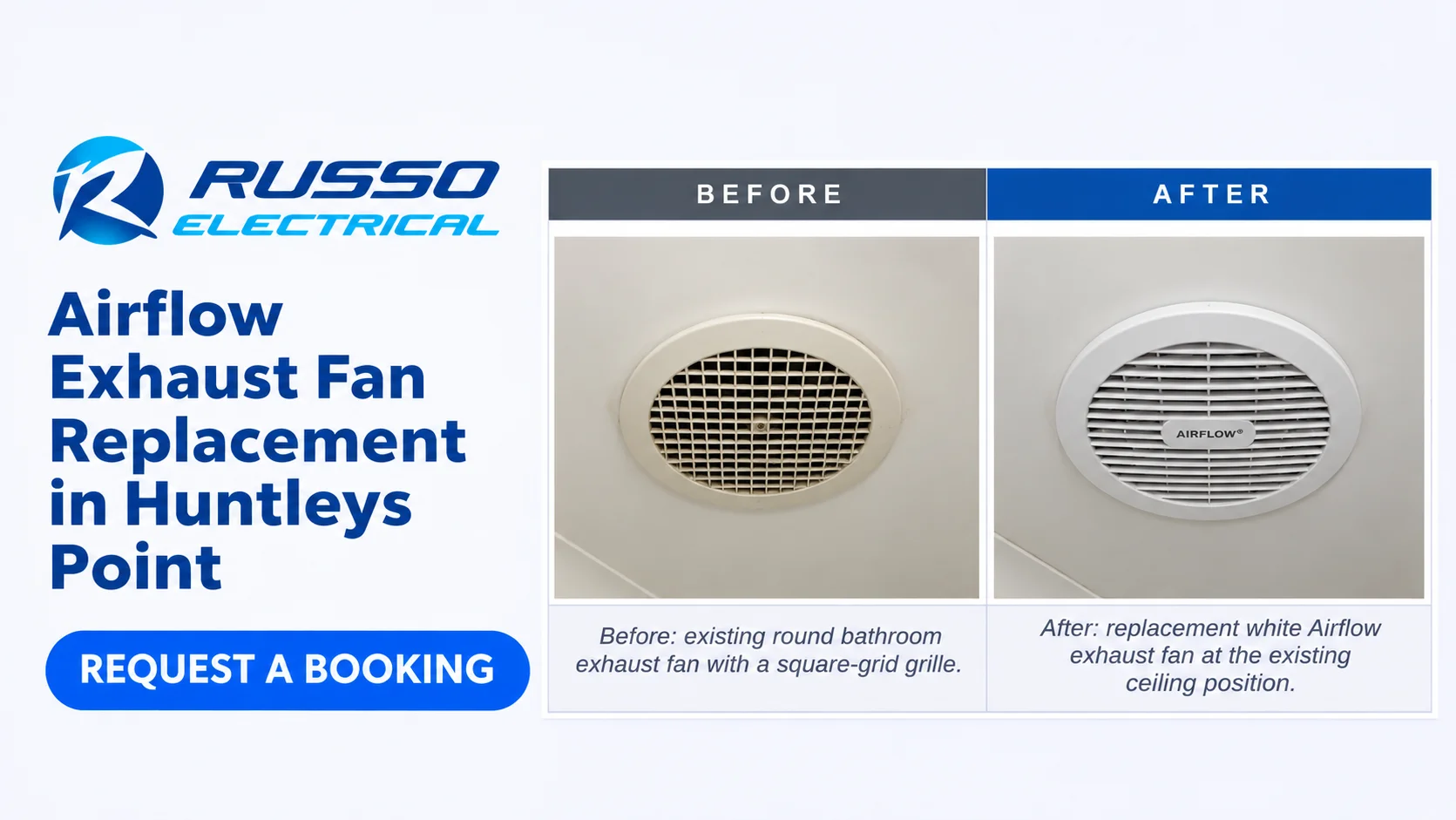
Airflow Exhaust Fan Replacement in Huntleys Point
White Airflow exhaust fans installed in a bathroom and ensuite, with insulation resistance and fan testing completed.
View the case study →Frequently Asked Questions
Should I call an electrician for one flickering light?
Not necessarily. First check whether the bulb is loose or faulty. But call an electrician if the flickering continues after replacing the bulb, affects multiple lights, or occurs with buzzing, heat, burning smells, or breaker trips.
Is a warm outlet always dangerous?
A slightly warm outlet can occur with some devices, but an outlet, switch, or wall plate that feels hot, smells burnt, is discoloured, or is getting warmer should be treated as urgent.
Can I reset a tripped breaker myself?
You can reset a breaker once if you can safely identify it and there are no signs of burning, sparks, heat, water, or damage. If it trips again, stop resetting it and call an electrician.
What does a burning electrical smell mean?
It may indicate overheating insulation, a loose connection, an overloaded circuit, or a failing component. Treat it as urgent, especially if it comes from a switch, outlet, light fitting, or switchboard.
Can a faulty appliance trip the breaker?
Yes. A faulty appliance can cause a circuit to trip. If the same appliance repeatedly trips the circuit, stop using it and have both the appliance and circuit checked.
What should I do if water gets into an outlet?
Do not touch it. If it is safe, switch off power at the switchboard, keep people away, and call an electrician urgently. Water ingress is an emergency electrical situation.
Does Russo Electrical serve Huntleys Point?
Yes. Russo Electrical serves Huntleys Point, Huntleys Cove, Hunters Hill, and surrounding Lower North Shore suburbs, with residential electrical services; call to discuss availability and quotes.
Final Thoughts
For Huntleys Point homeowners, electrical warning signs deserve prompt attention—particularly in older or waterfront properties where moisture, ageing wiring, and modern power demands can combine to create risk.
The most important signs to act on are burning smells, sparks, hot outlets or switches, shocks or tingling, buzzing or crackling sounds, repeated breaker or safety-switch trips, flickering lights, damaged wiring, and water near electrical components.
Russo Electrical provides residential electrical services in Huntleys Point and surrounding suburbs, including fault finding, switchboard upgrades, repairs and preventive maintenance. Call to discuss availability for urgent work. If you notice any urgent warning sign, turn off the affected circuit if it is safe, keep clear of the area, and call (02) 5839 3156.
Sources
U.S. Consumer Product Safety Commission (CPSC) — Electrical Safety Month Poster
Nationwide — Signs Your Electrical System Might Need Repair
Gold Medal India — Faulty Wiring Symptoms: 9 Warning Signs to Watch For
Texarkana Gazette — Which Electrical Warning Signs Should Homeowners Never Ignore?
Total Skills — Electrical Safety at Home: Warning Signs & When to Call an Electrician
PuroClean — Electrical Fire Causes: 9 Warning Signs & Prevention Tips
Country Living — 7 “Haunted House” Signs That Could Point to Plumbing or Electrical Problems
Reliance Home Comfort — Electrical Troubleshooting: 7 Warning Signs Every Homeowner Should Know
AAA Electrical Services — What to Do in an Electrical Emergency: Safety Guide
Liberty Mutual — Protecting Your Risk Against Electrical Fires
Route Electrical — Electrical Fire Prevention Tips to Protect Your Home
Top Rated Electricians — When Do You Need an Emergency Electrician?
Mr. Electric — Fire Prevention Month: 8 Electrical Fire Hazards Every Homeowner Should Know
Fornoff Electric — Helpful Tips: Electrical Services
Homebuilding — Does My House Need Rewiring? 7 Signs That It Could Be Time
Green Earth Sussex — 5 Warning Signs Your Sussex Home Needs Rewiring
Steel Electrical Services — When Should Electrics Be Rewired?
Prairie Electric — When to Rewire Your House
NSW Government — Electrical Compliance Requirements
NSW Government — When to Submit a Certificate of Compliance for Electrical Work (CCEW)
NSW Government — BCNSW eCert Portal
NSW Government — Smart Meter Safety and Installation Requirements
NSW Government — Electrical Standards, Rules and Notes
NSW Government — Electrical Installation Safety Inspection Instructions After a Flooding Event
NSW Government — Electrical Safety in the Home
NSW Government — Electrical Work
Russo Electrical — Electrician in Huntleys Point
Powerix — Electrician Huntleys Point | Complete Electrical Services
Top Electricians Sydney — Electrician Huntleys Point | Local Electrical Work