
Keeping an apartment’s electrical system in good condition involves more than replacing a failed globe or resetting a tripped switch. It means noticing changes, maintaining protective devices, organising repairs promptly and understanding where your responsibility ends and the owners corporation’s begins.
For apartment owners in Rhodes, that last point is particularly important. A problem that appears inside your apartment may involve shared wiring or equipment, while work in a garage, ceiling or meter room may require coordination with the building manager.
NSW Government guidance recognises these differences. Safety switches in strata buildings may be located inside an individual apartment or on common property, and the arrangements for testing them depend on where they are installed.
The foundation of good maintenance is prevention: observe problems early, keep records and use licensed professionals rather than attempting electrical repairs yourself.
Russo Electrical provides residential repairs, switchboard services and 24/7 emergency electrical work in Rhodes, Concord West, Homebush and surrounding suburbs. Its services include fault finding, electrical safety checks, lighting, power points and circuit upgrades.
Here are the practical maintenance steps worth building into your apartment-care routine.
1. Understand Which Electrical Equipment You Are Responsible For
Before arranging work, establish whether the affected equipment belongs to your lot or is common property.
Do not assume that everything inside your apartment is your responsibility. NSW Government guidance explains that wiring serving the building or other apartments can be common property even where it passes through an individual lot.
Similarly, equipment outside your apartment does not automatically fall outside your responsibility. The strata plan, registered by-laws, previous alterations and any applicable maintenance arrangements may affect the answer.
Why this matters
If you arrange work on shared infrastructure without checking, you may create access, approval or payment disputes. Conversely, delaying a report because you assume something is “strata’s problem” can leave a fault unresolved.
The NSW common property memorandum provides examples of electrical items associated with common property, including wiring serving more than one lot, shared light fittings, meter-room fuse boards and lifts. However, do not treat that document as a universal allocation for every building; confirm the arrangements applying to your scheme.
What to do before booking
For a non-emergency issue:
2. Know Where Your Apartment’s Safety Switches Are Located
One of the simplest maintenance steps is knowing where the protective devices are, and being able to identify them without opening electrical enclosures.
NSW notes that apartment safety switches may be located in an entry hallway, kitchen or linen cupboard. In other buildings, they may be in a shared power room, garage or another common area.
Record the location and any access procedure. That information is useful during a fault, a maintenance visit or a change of tenant.
Safety switches and circuit breakers do different jobs
According to NSW Government guidance:
| Device | Main purpose |
|---|---|
| Safety switch, also called an RCD | Helps protect people from severe electric shock by detecting current leakage and disconnecting power |
| Circuit breaker | Protects circuitry and wiring |
Some devices combine these functions. A safety switch has a “T” or “Test” button, but ask an electrician if you are unsure what is installed or which circuits are protected.
Having switches in a board does not automatically mean every circuit has appropriate safety-switch protection.
3. Test Safety Switches Regularly
NSW recommends testing household safety switches twice a year. Testing is important because the presence of a device does not establish that it is operating correctly.
For safely accessible devices within your apartment, follow the manufacturer’s instructions and NSW guidance. The government’s procedure includes notifying everyone in the home, pressing the test button, confirming that the relevant circuits lose power and then resetting the switch.
Plan the timing so an interruption will not unexpectedly affect work or other activities. If anyone relies on powered medical equipment, make appropriate arrangements before testing.
When to contact an electrician
Seek professional assistance if:
What if the switchboard is on common property?
Do not enter a restricted electrical room or operate shared equipment without authorisation.
NSW advises apartment owners to contact the strata manager or owners corporation and ask for common-property safety switches to be included in the scheme’s regular safety checks.
4. Do Not Treat Repeated Tripping as Normal
A switch that trips repeatedly is a reason to investigate, not an inconvenience to work around.
The cause needs diagnosis. Replacing a protective device or repeatedly resetting it without understanding the problem may leave the underlying fault unresolved.
Keep a simple record:
5. Report Damaged Power Points and Switches Promptly
Power points are easy to overlook because most are behind furniture or appliances. Include visible fittings in your routine observations.
Arrange an assessment if you notice:
NSW identifies damaged outlet sockets, loose wiring and sparking power points as visible electrical hazards in rental-property condition reporting. These are not fittings to keep using while waiting for a more convenient time.
Do not remove the cover, tighten internal connections or replace the fitting yourself.
Plan additional outlets rather than improvising
If the apartment’s layout no longer suits how you use it, discuss additional outlets or dedicated circuits with an electrician.
Russo Electrical provides power points, circuit alterations and testing for appliances, renovations and changing household needs. The scope should consider the circuit, not simply the number of available sockets.
Confirm any strata approvals or restrictions before altering walls or shared infrastructure.
6. Investigate Flickering Lights Instead of Assuming the Globe Is the Problem
An occasional failed globe is different from recurring flickering or a light that behaves inconsistently.
Record whether the issue affects:
7. Keep Smoke-Alarm Responsibilities Clear
Smoke alarms deserve their own maintenance arrangements rather than being treated as an occasional electrical accessory.
For an owner-occupied apartment, confirm the manufacturer’s maintenance instructions and the building’s arrangements. If the alarm forms part of a shared fire-safety system, coordinate with strata or building management before organising work.
For rental apartments, the landlord’s obligations are specific.
NSW states that landlords must ensure smoke alarms, including heat alarms, are working and must check them every year. Responsibility cannot be transferred to tenants through a tenancy agreement.
What if strata maintains the alarms?
The owners corporation may have responsibility for repair or replacement under the building’s arrangements. However, NSW makes clear that landlords still have obligations to ensure alarms in their rental properties are working.
Ask the property manager and strata manager to clarify:
8. Treat Leaks Near Electrical Equipment as More Than a Plumbing Issue
A ceiling leak can involve more than paint and plaster. If water reaches a fitting, switchboard or other electrical equipment, keep clear and report both the leak and the electrical concern.
Do not touch wet equipment or try to dismantle a fitting to release water.
In an apartment, reporting the location clearly matters because the water source and affected electrical equipment may involve different lots or common property. Electrical services passing through a lot can still be common property where they serve the building or other apartments.
Tell building management:
9. Plan Appliance Upgrades Before Installation Day
A new induction cooktop, oven or other major appliance may require more than a like-for-like connection.
Before purchasing, provide the electrician with the product specifications and explain whether the apartment already has a suitable supply and installation arrangement.
Russo Electrical’s services include capacity checks, dedicated circuits, appliance connections and induction cooktop installation with isolation and testing.
Why strata coordination matters
A proposed cable route or supply alteration may involve shared walls, risers, meter rooms or other common property.
Do not assume a contractor can proceed simply because the appliance is inside your apartment. Confirm the necessary approval and access arrangements first.
NSW guidance identifies shared electrical wiring and building services as potential common property, including where they pass through an individual lot.
Early coordination helps avoid booking an installation that cannot proceed because access or authorisation is missing.
10. Approach EV Charging as a Building Infrastructure Project
Installing an EV charger in an apartment car space is not the same as adding a charger at a detached house.
The project may involve shared electrical capacity, common-property cable routes, metering, billing and future demand from other residents.
NSW’s residential strata EV guidance explains that the owners corporation and strata committee are responsible for developing an EV charging strategy, selecting the appropriate approach and ensuring approvals are in place.
Before buying a charger, ask:
Russo Electrical offers EV charger installation with assessment of switchboard capacity, cable routes and charging needs. Any apartment project should also fit the building’s approved arrangements.
11. Keep Electrical Maintenance Records
A useful maintenance file makes future work easier to organise.
Keep:
NSW states that electrical installation work must be performed by a licensed electrician and supported by a uniquely numbered Certificate of Compliance for Electrical Work showing that it has been tested and complies with regulations.
Documentation also helps distinguish what was actually inspected from what was outside the scope. “An electrician attended last year” is less useful than a record of the circuits, fittings or faults assessed.
12. Set an Inspection Schedule Based on Your Apartment
There is no need to invent a universal annual inspection rule for every owner-occupied apartment.
Professional inspection timing should reflect the installation’s history, condition, previous findings and changes in use. The twice-yearly safety-switch recommendation is a specific test routine, not a substitute for a full assessment.
Discuss a professional check when:
Newer buildings still need maintenance. Conversely, an older building does not automatically require wholesale replacement of its electrical equipment. The findings should guide the work.
A Practical Maintenance Checklist
| Task | Suggested trigger or timing |
|---|---|
| Identify your safety-switch location | On moving in and after relevant alterations |
| Test accessible household safety switches | Twice a year, following instructions |
| Report damaged fittings | As soon as noticed |
| Investigate recurring trips or flickering | When the pattern appears; do not wait for a routine visit |
| Confirm smoke-alarm servicing | Follow the manufacturer and building arrangements; annual checks apply to NSW landlords |
| Review appliance electrical requirements | Before purchasing or booking installation |
| Check strata approvals | Before work affecting common property |
| Update maintenance records | After inspections, repairs and upgrades |
The safety-switch and rental smoke-alarm timings come from NSW Government guidance; the other entries are practical organisation prompts rather than universal statutory inspection intervals.
Know When It Is an Emergency
If there is smoke or fire, leave the affected area and call 000. Do not delay evacuation to investigate the electrical cause.
For an urgent electrical concern without an active fire, keep away from damaged or wet equipment and seek professional assistance. Alert building management where shared services, access or other residents may be affected.
Russo Electrical advertises 24/7 emergency electrical services in Rhodes for power outages, faults and urgent safety issues. Call 0485 009 500 to describe the situation and confirm attendance arrangements.
Do not enter shared switch rooms or attempt to restore building services yourself.
How Russo Electrical Can Help Rhodes Apartment Owners
For local residential electrical work, visit our Rhodes electrician service page.
Russo Electrical serves Rhodes, Concord West and Homebush with electrical repairs, switchboard work and emergency support.
Its residential service offering includes:
When booking apartment work, supply the unit address, a description of the issue, useful photos and the building manager’s access requirements. Clarify whether the work is authorised by you, a property manager or the owners corporation.
Also ask about call-out charges, diagnostic time and whether repair costs will be confirmed before work proceeds. Availability and charges should be confirmed directly for the particular job.
Electrical Maintenance Projects in Rhodes
Examples of electrical maintenance and lighting improvements completed by Russo Electrical in Rhodes.
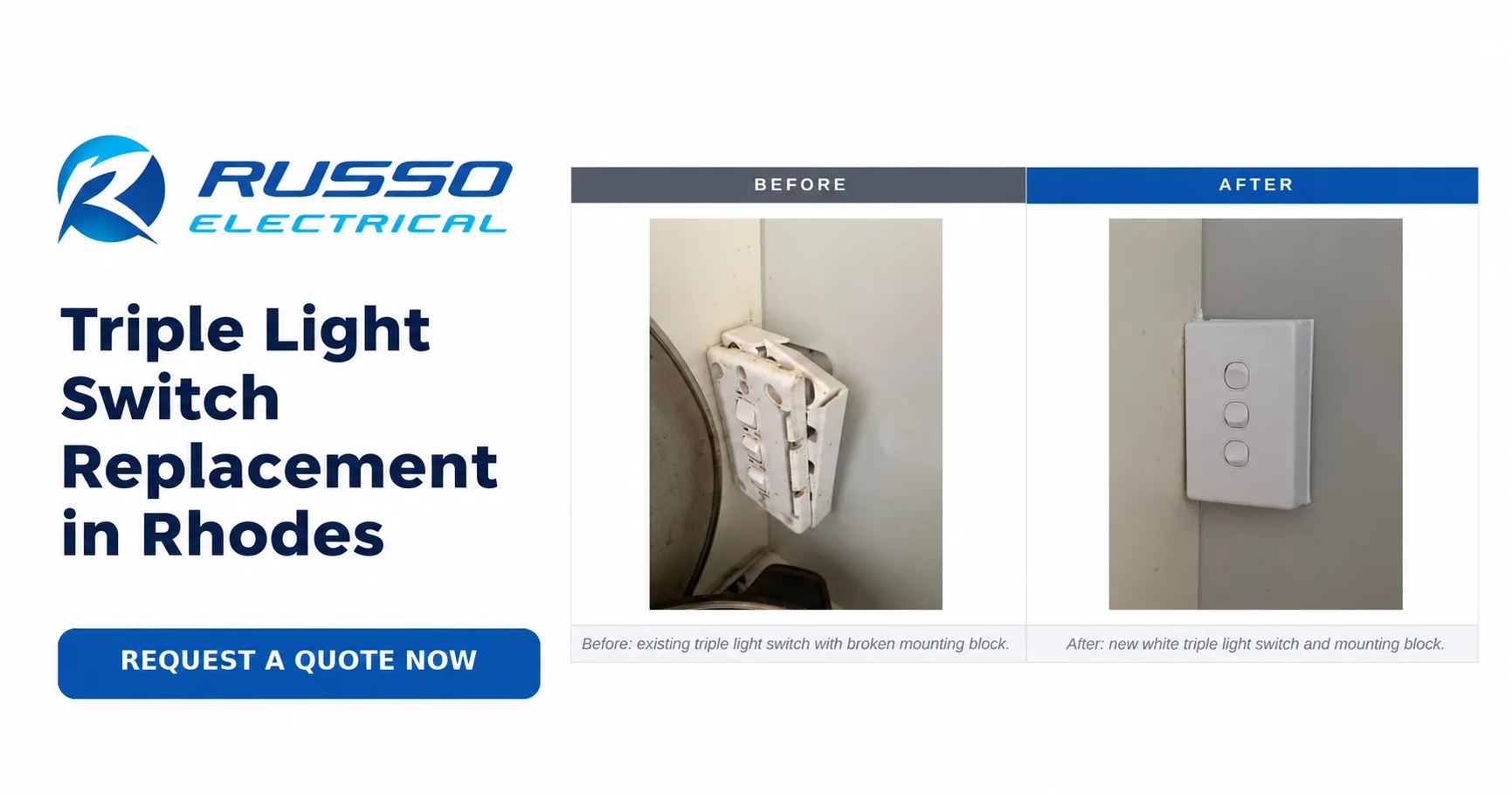 Rhodes electrical projectTriple Light Switch Replacement in RhodesAn example of residential light switch replacement work.View the project →
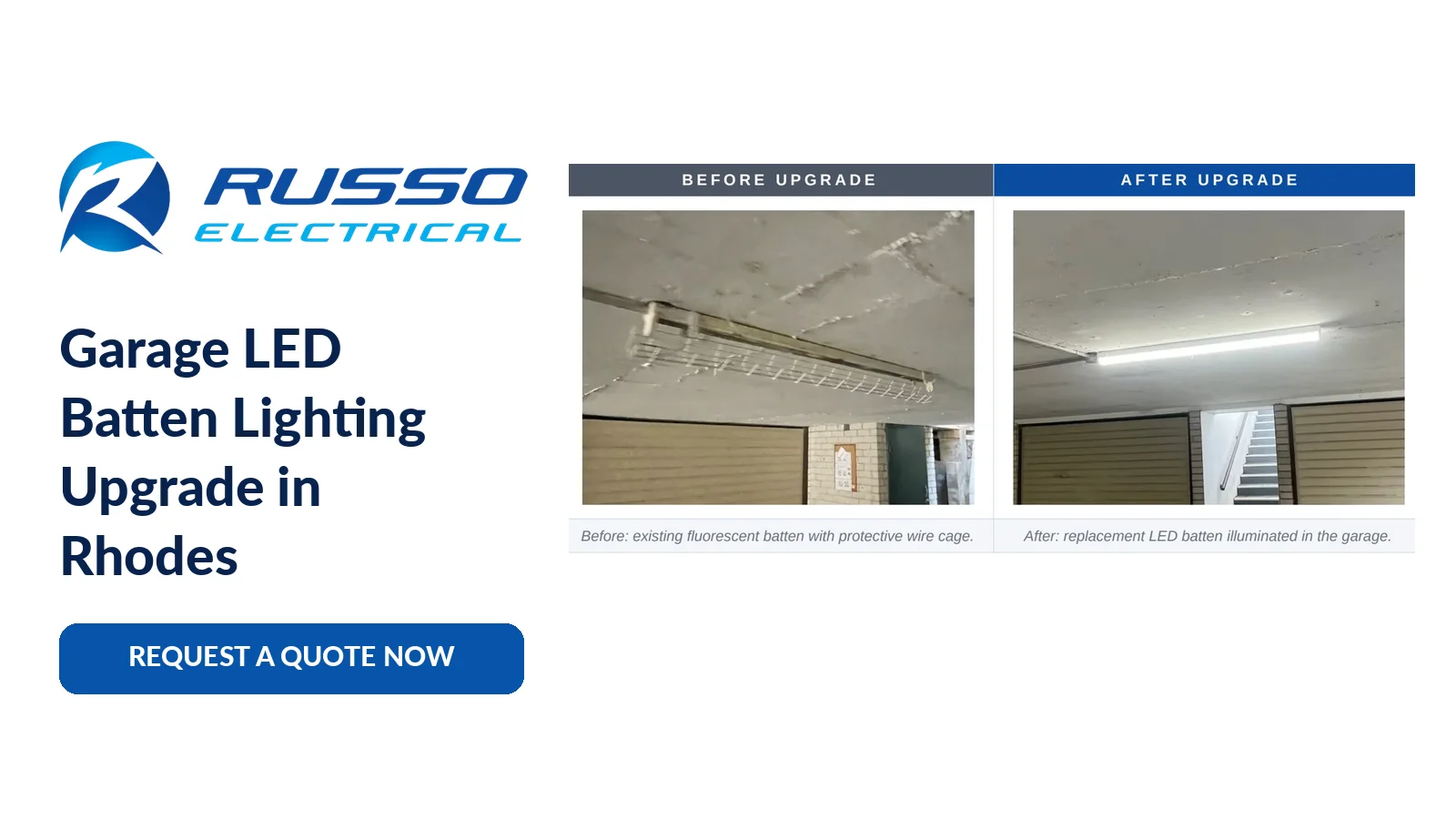 Rhodes electrical projectGarage LED Batten Lighting Upgrade in RhodesA completed garage lighting improvement using LED battens.View the project →
Frequently Asked Questions
Is electrical wiring inside my apartment always my responsibility?
No. Wiring serving other lots or the building may be common property even if it passes through your apartment. Confirm the position using the strata records and building management advice.
How often should I test safety switches?
NSW recommends twice a year. If the devices are on common property, coordinate testing through the strata manager or owners corporation.
Should I keep resetting a tripping safety switch?
No. If it will not reset or the problem recurs, arrange professional investigation rather than continuing to energise the affected installation.
Can I replace a power point or light fitting myself?
Not unless appropriately qualified. NSW warns unqualified people not to replace power points, lights, switches or ceiling fans.
Who maintains smoke alarms in a rental apartment?
Landlords must ensure alarms work and arrange the required checks. The owners corporation may have repair or replacement responsibilities, but landlords retain obligations.
Can Russo Electrical work in Rhodes apartments?
Russo Electrical advertises apartment and unit switchboard services, repairs and emergency electrical work in Rhodes. Confirm the job scope and any strata access requirements before booking.
Stay on Top of Maintenance Before Small Problems Disrupt Apartment Life
Good apartment electrical maintenance combines simple observation, regular protective-device testing, prompt fault reporting and clear coordination with strata.
Know where your safety switches are, keep maintenance records and avoid assuming that either the apartment owner or owners corporation is responsible for every issue. Above all, leave fixed electrical work to a licensed professional.
For Rhodes owners arranging repairs, inspections or upgrades, Russo Electrical offers local electrical services and 24/7 emergency support. Provide the details early so the scope, access and authorisation can be clarified before the visit.
Electrical Safety and Strata Resources
NSW Government: Electrical safety in the home
NSW Government: Smoke alarms in rental properties
NSW Government: Drive Electric NSW
See Russo Electrical’s Rhodes electrician page and residential electrical case studies.