
Solar garden lights are designed for outdoor use, but that does not mean every model can withstand the same amount of water.
Many can tolerate rain and splashes. Others offer stronger protection against water jets or temporary immersion. The difference comes down to the product’s ingress protection rating, usually written as an IP rating, and the manufacturer’s installation instructions.
The short answer is: solar garden lights may be water-resistant, but waterproof is not a promise of unlimited protection. A light suitable for rain may still fail if it sits in a flooded garden bed, is cleaned with a pressure washer or has damaged seals.
Before buying solar lighting for your Sydney garden, check the rating of the complete product, confirm where it can be installed and understand what the warranty covers.
This guide explains the ratings, common mistakes and when it is worth considering professionally installed garden lighting instead.
What Does “Waterproof” Mean for Solar Garden Lights?
“Waterproof” is often used as a broad product description. An IP rating is more useful because it describes the protection offered against specific types of ingress.
IP stands for ingress protection. The rating uses two digits:
For example, IP44 and IP65 are not interchangeable. IP44 provides protection against solid objects larger than 1 mm and water splashes from any direction. IP65 indicates a dust-tight enclosure with protection against water jets. Neither rating establishes suitability for submersion.
The practical lesson is simple: do not rely on the word “waterproof” alone. Look for the actual rating and read the product instructions.
Understanding Common IP Ratings
The following table explains common ratings you may encounter when comparing outdoor lights.
| IP rating | What the rating describes | What you should not assume |
|---|---|---|
| IP44 | Protection against objects larger than 1 mm and water splashes from any direction | It is not dust-tight or immersion-rated |
| IP65 | Dust-tight protection and resistance to water jets | It is not rated for submersion |
| IP67 | Dust-tight protection and temporary immersion under specified test conditions, commonly described as up to 1 metre for 30 minutes | It is not automatically suitable for permanent underwater use |
These ratings describe defined protection levels, not an unlimited guarantee against every outdoor condition. Product instructions and installation requirements still matter.
Is IP44 enough for a garden light?
IP44 describes splash protection. Whether that is appropriate depends on the product’s intended use and the location.
A sheltered decorative light and a fitting positioned close to ground level in an exposed garden face different conditions. Do not assume that a splash-protected product is suitable for flooding, direct hose jets or every exposed location.
Is IP65 waterproof enough for heavy rain?
IP65 provides greater protection against water exposure than a splash-only rating: it covers water jets and a dust-tight enclosure.
However, it does not establish protection against immersion. If the light becomes submerged in pooled water, the exposure is different from the conditions represented by an IP65 rating.
Can IP67 lights stay underwater?
Not simply because they carry an IP67 rating.
IP67 describes temporary immersion under specified conditions. Permanent underwater lighting requires a product explicitly designed and approved by its manufacturer for that application. Do not turn a garden light into a pond light based on the IP number alone.
Can Solar Garden Lights Be Left Outside in the Rain?
Often, yes, provided the manufacturer identifies the product as suitable for that exposure and it is installed correctly.
The important question is not just whether rain falls on the light. It is what happens to the water afterwards.
Compare these situations:
Why a “Waterproof” Solar Light May Still Fail
An IP rating is useful, but it does not eliminate the need to choose and maintain the product properly.
1. The Exposure Exceeds the Rating
A splash-rated light should not be treated as immersion-rated. Likewise, a fitting rated for water jets should not automatically be left in standing water.
Water protection is specific to the type of exposure represented by the rating.
This is especially relevant for low-lying garden beds and paths where water can collect.
2. The Product Is Installed Contrary to Its Instructions
A manufacturer may specify how the light should be positioned, assembled or mounted.
Before installing, check whether the instructions address:
Do not assume the advertised rating applies regardless of how the product is assembled or positioned. If the instructions are unclear, ask the supplier before installation.
3. Different Components May Have Different Requirements
Some solar lighting kits include a separate panel, multiple lights and connecting cables.
When comparing products, ask whether the stated rating applies to the entire kit or only to particular components. Also check how connectors must be protected and positioned.
A headline rating is not enough if the instructions leave uncertainty about the parts exposed in your garden.
4. The Enclosure Is Damaged
Check for cracks, loose covers and other visible damage before continuing to use a light.
An IP rating describes enclosure protection. It should not be taken as assurance that a damaged product retains the same protection.
Contact the supplier about an approved repair or replacement rather than attempting to restore the rating with tape or household sealant.
5. Cleaning Introduces a Different Type of Exposure
Do not assume that a light which survives rain can be pressure-washed.
Splashing, water jets and immersion are separately described exposure categories. Use only the cleaning method permitted by the manufacturer.
Why Solar Lights Stop Working After Rain
If several garden lights fail after wet weather, water damage may be a concern. But timing alone does not prove that water has entered the electronics.
Before deciding the lights are beyond repair, use the manufacturer’s troubleshooting instructions and record what happened.
Useful observations include:
Do not assume drying repairs the damage
A product appearing dry does not establish that its original protection has been restored.
If water appears to have entered a sealed compartment, stop using the affected unit and contact the supplier. Ask whether inspection, replacement or an approved service procedure is required.
Avoid advice that tells you to drill drainage holes or open sealed compartments without reference to the product instructions.
How to Choose Solar Garden Lights for Your Location
The best choice depends on where the lights will be used, not just how they look in a product photograph.
Start with the Water Exposure
Walk through the garden and identify the proposed positions.
Consider:
Then compare that exposure with the product’s intended use and water-protection rating. The difference between splash, jet and immersion protection is more informative than a generic weatherproof claim.
Look for Clear Product Information
A useful listing should identify the product, rating and installation requirements.
If the supplier cannot clarify whether the light is suitable for your proposed location, choose a product with better documentation rather than relying on an unsupported claim.
Check Serviceability
Before purchasing, ask:
Consider the Whole Lighting Job
Decide whether you want decoration, occasional ambience or lighting that must reliably serve a practical purpose.
That brief will help you compare options more meaningfully. A row of decorative lights and a planned lighting system for steps, paths and entrances are different projects.
Where Should You Avoid Installing Solar Lights?
Do not install an ordinary solar garden light in a location outside its stated application.
Examples to discuss with the supplier include:
Maintaining Solar Garden Lights
Follow the instructions for your specific product rather than using a universal repair routine.
A sensible maintenance checklist is to:
Solar Garden Lights vs Professionally Installed Garden Lighting
Solar lights are one option for outdoor spaces, but they are not the only one.
If you are dissatisfied with the lighting coverage, positioning or reliability of your existing setup, it may be worth discussing a broader lighting design with an electrician.
Rather than starting with a specific fitting, describe the outcome:
Russo Electrical provides garden lighting, feature lighting, controls, replacements and other outdoor lighting upgrades across Sydney’s Inner West, Lower North Shore and Eastern Suburbs.
Does an electrician repair solar stake lights?
Do not assume that every electrical contractor repairs individual consumer solar products.
For a self-contained unit, the manufacturer or retailer may be the appropriate first contact for warranty support, replacement parts or troubleshooting.
An electrician becomes particularly relevant when the proposed work involves fixed outdoor lighting, circuits, controls or investigation of a wider electrical issue. Confirm the job’s suitability before booking.
Russo Electrical’s services include outdoor lighting and fault finding, but its service page does not promise repairs to every brand of standalone solar garden light.
How Russo Electrical Can Help with Outdoor Lighting
Russo Electrical offers new lighting, replacements, garden lighting, feature lighting and controls. Its process begins with the homeowner supplying the job details, suburb and useful photos. The team then assesses the information, arranges an inspection where required and explains the recommended scope.
For an outdoor-lighting enquiry, provide:
Related Outdoor Lighting Projects
These are examples of professionally installed electrical lighting, rather than standalone solar garden lights. They show other options to discuss when planning reliable lighting for outdoor spaces.
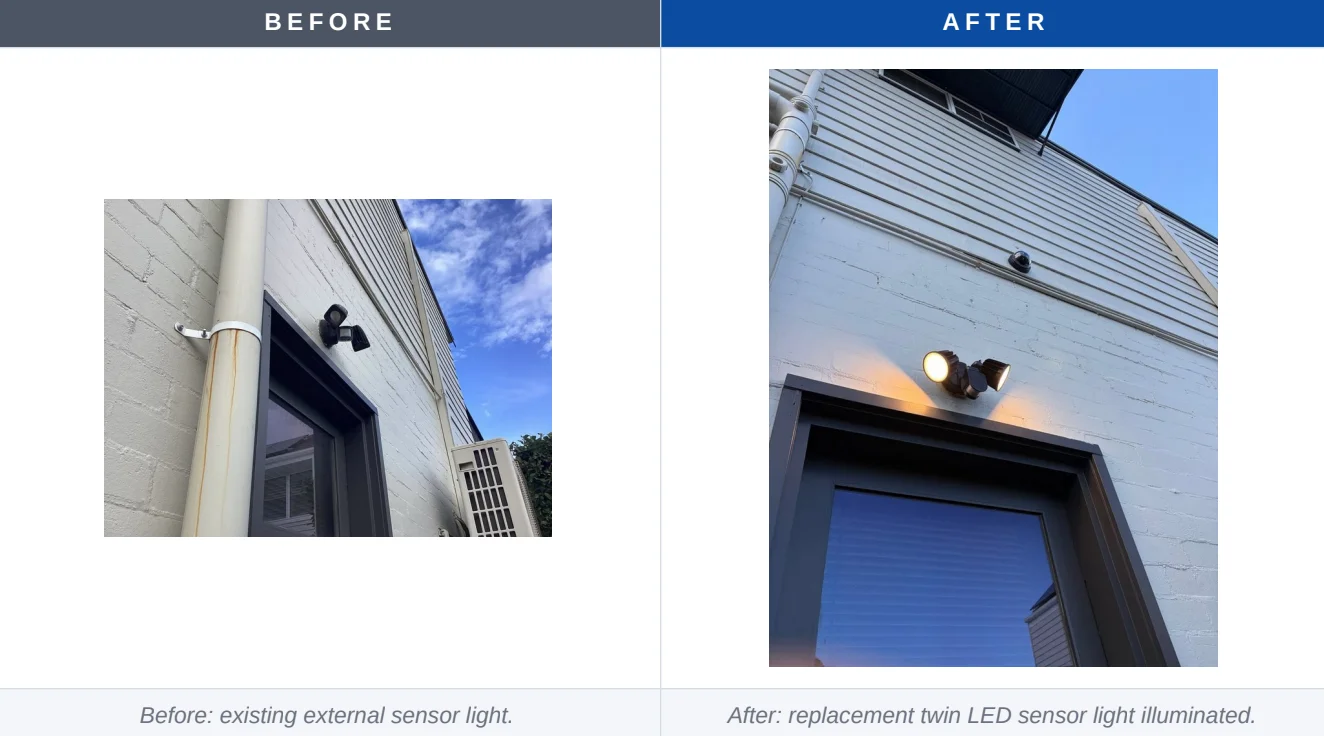 Outdoor lighting projectExternal LED Sensor Light Replacement in Five DockAn outdoor sensor light replacement shown in before-and-after project photos.View project →
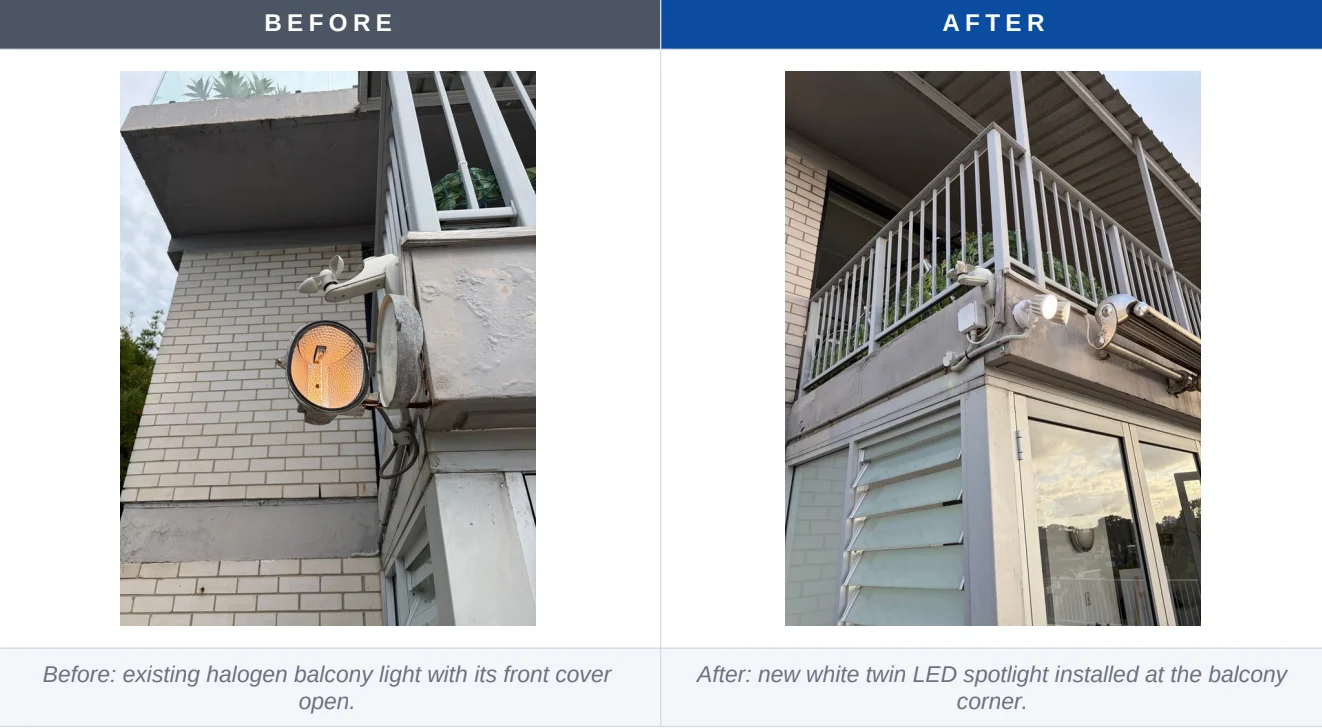 Outdoor lighting projectBalcony LED Spotlight Upgrade in DrummoyneAn outdoor balcony light upgraded from halogen to a twin LED spotlight.View project →
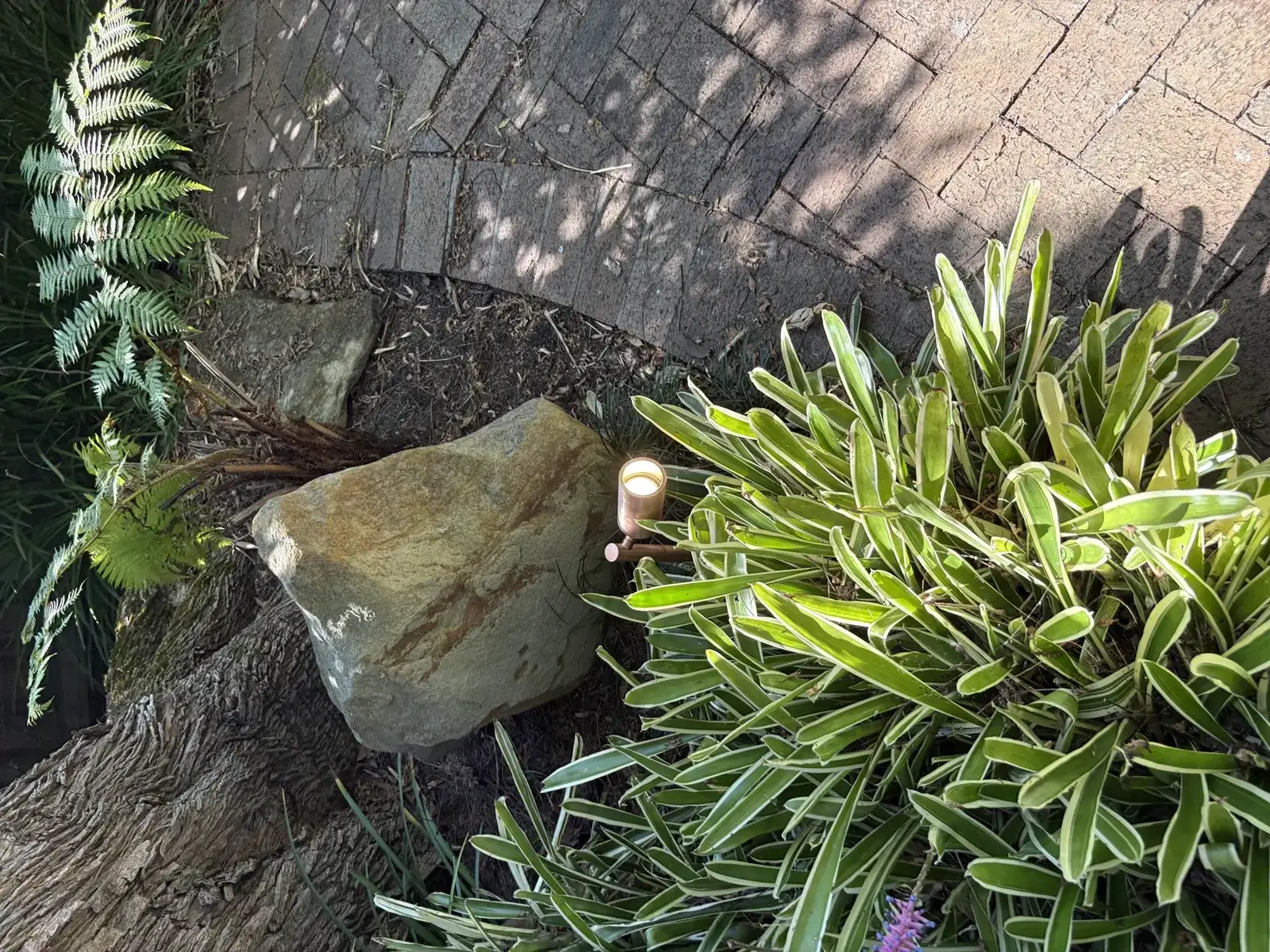 Outdoor lighting projectGarden and Outdoor Lighting in GladesvilleExplore a local garden lighting project featuring outdoor fittings and garden spike lighting.View project →
Frequently Asked Questions
Are all solar garden lights waterproof?
No. Protection varies by model. Check the IP rating and manufacturer’s instructions rather than assuming every outdoor product can tolerate the same exposure.
Can solar garden lights survive heavy rain?
A product may be suitable for rain, but the rating and instructions determine its limits. Rain exposure is different from standing water or submersion.
What is the difference between IP44 and IP65?
IP44 provides protection against objects larger than 1 mm and splashing water. IP65 is dust-tight and protects against water jets. Neither is an immersion rating.
Can I put IP65 solar lights in a pond?
Not on the strength of that rating. IP65 does not establish suitability for submersion. Use a product explicitly intended for the underwater application.
Does IP67 mean a light can stay underwater permanently?
No. IP67 describes temporary immersion under specified conditions. It is not automatic approval for permanent underwater use.
Can I clean garden lights with a pressure washer?
Do not assume so. Follow the manufacturer’s cleaning instructions; ordinary rain resistance does not establish resistance to pressure washing.
Should I seal a leaking light with silicone?
Do not assume an improvised repair restores the product’s rating. Ask the manufacturer about approved repair or replacement rather than modifying the enclosure.
Can Russo Electrical help replace my outdoor lighting?
Russo Electrical offers outdoor and garden lighting replacements, feature lighting and controls. Send the team details of the project to confirm the appropriate scope.
Choose for the Conditions, Not the Marketing Label
Solar garden lights can be suitable for wet weather, but their limits vary. A splash-resistant light, a jet-resistant light and a temporarily immersion-rated light offer different forms of protection.
Check the IP rating, read the instructions and consider where water goes in your garden. Avoid assuming that “waterproof” means flood-proof, pressure-washer-proof or suitable for a pond.
If your outdoor area needs a more considered lighting solution, Russo Electrical provides garden lighting, replacements and controls across its Sydney service areas.
Sources and Further Reading
RS DesignSpark: IP Rating Chart, What the Numbers Mean.
LEDVANCE: Understanding Waterproof IP Ratings for Commercial Lighting.
Russo Electrical: Garden and outdoor lighting in Gladesville and completed electrical projects.