
An older home can have a sound structure, a renovated kitchen and well-maintained interiors while still containing electrical equipment that needs attention. Wiring is largely hidden, and a switchboard that supplies power reliably does not necessarily tell you whether every circuit has suitable protection.
For owners of older homes in Ryde, the safest approach is to check what you can observe, maintain protective devices and arrange professional assessment where the installation’s condition is unclear.
NSW Government guidance recommends considering an electrical inspection for homes built before the 1980s to identify aged or faulty wiring. It also strongly recommends asking an electrician to check safety-switch protection in properties built before 2000. Neither recommendation means every older home automatically needs rewiring or a new switchboard. The findings should determine the work.
This checklist separates homeowner observations from work that requires a licensed electrician. The priority is safety, not dismantling fittings or testing wiring yourself.
Russo Electrical provides electrical repairs, switchboard upgrades, inspections and 24/7 emergency support in Ryde, Putney, West Ryde and surrounding suburbs.
Before You Start: Know the Limits of a Homeowner Check
This checklist is a planning and observation tool, not a certificate that your installation is safe.
Do not remove switchboard covers, open power points, disturb old wiring or disconnect light fittings. NSW warns that DIY electrical work is dangerous and illegal. Unqualified people should not replace power points, lights, switches or ceiling fans, or undertake electrical maintenance beyond changing a globe.
If you see smoke or fire, leave the affected area and call 000. Do not delay evacuation to investigate.
If equipment is wet, visibly damaged or unsafe to approach, keep clear and seek professional assistance.
Quick Electrical Safety Checklist
Use this table as a starting point, then work through the explanations below.
| Check | What you can do | When to involve an electrician |
|---|---|---|
| Electrical history | Find previous invoices, reports and certificates | The history is unclear or concerns remain |
| Safety switches | Identify accessible devices and follow test instructions | Protection is uncertain, testing fails or a switch will not reset |
| Switchboard | Observe its condition without opening covers | It is damaged, poorly understood or associated with recurring faults |
| Power points and switches | Look for visible damage | Fittings are loose, broken, sparking or otherwise suspect |
| Lighting | Record recurring problems | Lights flicker, fail intermittently or need hardwired replacement |
| Wiring | Leave exposed or old wiring untouched | Old or damaged wiring is visible |
| Smoke alarms | Test and maintain according to guidance | A hardwired alarm needs repair or replacement |
| Outdoor equipment | Note damage or water exposure | Electrical fittings or wiring may be affected |
| Appliance upgrades | Gather product specifications | Capacity, circuits or installation requirements need assessment |
| Records | Keep findings and documentation | Ask for a written scope and applicable compliance paperwork |
The electrical checks and restrictions are based on NSW Government guidance. Smoke-alarm maintenance follows Fire and Rescue NSW recommendations.
1. Establish What Has Already Been Upgraded
Start with the property’s history rather than assumptions about its age.
A house built many decades ago may have been substantially rewired. Another may have received only a new kitchen circuit or replacement switchboard. Recent fittings do not establish the condition of the wiring behind them.
Look for:
NSW recommends professional inspection where aged or faulty wiring may be present and requires licensed electricians to provide compliance documentation for electrical installation work. Those records help establish what was actually completed.
Questions worth asking
When discussing the property with an electrician, ask:
2. Check Whether Safety Switches Are Installed
Safety switches, also called residual current devices or RCDs, help protect people from severe electric shock. They detect current leakage and disconnect electricity rapidly.
NSW advises that homes built during or after 2000 will usually have safety switches. For earlier properties, it strongly recommends having an electrician check.
Do not confuse safety switches with circuit breakers
The distinction matters:
A safety switch helps protect people from severe electric shock.
A circuit breaker protects circuitry and wiring.
Safety switches have a “T” or “Test” button. Some devices combine functions, so ask an electrician if you are unsure what is installed.
Check coverage, not just presence
Finding one safety switch does not establish that every circuit is protected.
NSW notes that older houses may have a single safety switch protecting several circuits. A device only protects the circuits connected through it, and homeowners should ask whether their installation has appropriate coverage.
For your checklist, record “coverage confirmed” only after you understand which circuits are protected, not simply because you can see a test button.
3. Test Safety Switches Twice a Year
NSW recommends testing household safety switches every six months.
For safely accessible equipment, follow the manufacturer’s instructions and government guidance. Notify everyone in the house before testing because the relevant circuits should lose power.
The NSW procedure includes:
When does the test need professional follow-up?
Contact a licensed electrician if:
4. Have the Switchboard Assessed
A homeowner can note the switchboard’s location and visible condition without opening it.
Professional assessment is appropriate where the board’s condition, protection or suitability is uncertain. NSW specifically recommends asking an electrician to check switchboard condition and whether safety switches are fitted.
Useful points to discuss include:
Does an older switchboard automatically need replacing?
No. The recommendation should follow assessment.
A switchboard replacement may be justified by its condition or the requirements of planned work, but it is not a universal solution to every electrical problem. Wiring, fittings and connected equipment may require separate investigation.
Russo Electrical provides switchboard upgrades and fault assessment for homes and apartments in Ryde.
5. Look for Damaged Power Points and Switches
Walk through the home and observe accessible fittings without removing covers.
Report:
NSW lists loose or damaged sockets, loose wiring and sparking power points as visible electrical hazards in rental-property reporting. The same observations are useful reasons for an owner-occupier to seek advice.
Do not keep using a damaged fitting because it still works
Continued operation does not establish that the fitting is safe.
Stop using suspect equipment and arrange assessment. Do not wedge plugs into place, remove a faceplate or attempt to tighten internal connections.
Power point and switch replacement is not permitted DIY work for an unqualified homeowner.
6. Leave Old or Exposed Wiring Untouched
Older wiring deserves particular care.
NSW explains that some older cables used rubber insulation that deteriorates and crumbles over time. This can expose conductors and increase the risk of fire or electric shock.
If renovation work, a loose fitting or another event reveals old wiring:
Is a full rewire necessary?
The extent of work depends on the findings.
The problem may be confined to a fitting or circuit, or a wider inspection may reveal more extensive deterioration. Ask the electrician to explain the evidence, the affected areas and the recommended scope.
The age of the house is a reason to investigate, not a diagnosis by itself.
7. Investigate Repeated Trips and Lighting Problems
Make recurring electrical symptoms a separate item on your checklist.
Examples include:
Russo Electrical’s capacity guidance recommends assessment when breakers trip under household load, lights dim under load or previous electricians have raised concerns about the supply.
Keep a fault record
Without recreating the problem, note:
8. Maintain Smoke Alarms on Their Own Schedule
Smoke alarms need regular maintenance even when the electrical installation appears reliable.
Fire and Rescue NSW recommends:
| Timing | Maintenance |
|---|---|
| Every month | Test the alarm using the test button |
| Every six months | Vacuum dust from the alarm |
| Every year | Replace removable lead or alkaline batteries |
| Every ten years | Replace the alarm, or earlier if the manufacturer specifies |
Sealed lithium batteries are not treated like ordinary removable batteries. Follow the instructions for the alarm installed in your home.
Hardwired alarms still need attention
Do not assume a hardwired alarm lasts indefinitely. Fire and Rescue NSW says all smoke alarms need replacement at least every ten years.
If replacement requires electrical work, arrange an appropriately licensed professional rather than disconnecting it yourself.
9. Check Outdoor Areas Without Disturbing Equipment
Include accessible outdoor fittings in your observations:
For homes with solar, remember that disconnecting mains power does not necessarily make the solar equipment safe. NSW warns that panels and their cables can continue generating electricity in daylight. Wet or storm-damaged solar equipment must not be assumed safe.
If components are wet or affected by damage, keep clear and contact an appropriate professional.
10. Review Electrical Capacity Before Major Upgrades
A safety checklist should consider planned changes as well as existing faults.
Before buying an induction cooktop, EV charger or other major electrical equipment, provide the specifications to an electrician.
Russo Electrical recommends capacity assessment where household loads cause tripping or dimming, or where the switchboard and incoming supply may be limiting factors.
Ask:
11. Keep Repairs Separate from Optional Improvements
An inspection may identify several types of work. Ask for clear priorities.
A useful written explanation separates:
12. Check Licensing and Retain Compliance Records
Before agreeing to installation work, check the contractor’s current licence.
NSW recommends verifying the licence on the public register and confirming that the person carrying out the work holds the appropriate credentials.
Electrical installation work must be tested, and the electrician must provide a uniquely numbered Certificate of Compliance for Electrical Work.
Keep the certificate with:
What If Your Ryde Property Is Rented Out?
Landlords must ensure the property is safe and fit to live in.
NSW requires condition reports to address visible electrical hazards, smoke alarms and whether a working safety switch is present. Testing is the way to establish whether the safety switch operates.
Electrical faults in a rental property are considered urgent repairs. Tenants should report them to the landlord or agent promptly so arrangements can be made.
Do not ask tenants to investigate wiring or replace fixed fittings. Ensure there is a clear reporting process and retain the repair documentation.
How Often Should an Older Home Be Professionally Inspected?
Do not confuse specific maintenance intervals with a universal inspection rule.
The guidance cited here recommends:
Safety-switch testing every six months
Smoke-alarm testing monthly and cleaning every six months
Professional consideration of aged or faulty wiring in pre-1980s homes.
It does not establish one professional inspection interval for every owner-occupied home.
Discuss timing with the electrician based on the installation’s history, current condition, previous findings and planned changes. Do not wait for a scheduled visit if an active fault appears.
How Russo Electrical Can Help Ryde Homeowners
For locally available repairs and assessments, see our Ryde electrician page.
Russo Electrical advertises repairs, switchboard upgrades and 24/7 emergency services in Ryde, Putney and West Ryde. Its local service includes assessment of wiring, earthing, safety switches and switchboard concerns.
When booking, explain whether you want:
Call 0485 009 500 to discuss the job, and confirm current availability, call-out charges, diagnostic fees and the proposed inspection scope. Emergency attendance is advertised, but the timing and charges for your situation should be confirmed directly.
Nearby Electrical Maintenance Projects
These are completed jobs in nearby suburbs, not in Ryde itself. They illustrate switchboard and power point maintenance work.
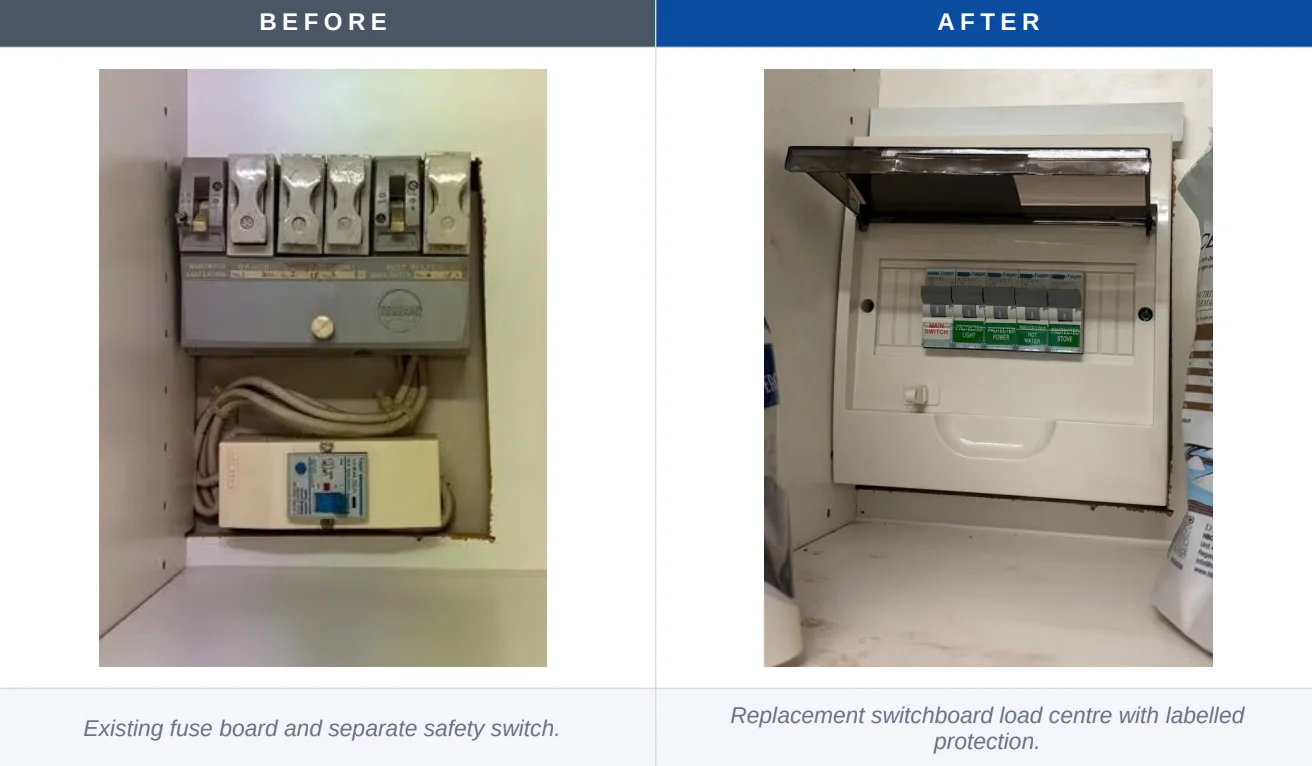 Nearby completed projectSwitchboard Load Centre Upgrade in GladesvilleAn older fuse board replaced with a load centre and RCBO protection.View the project →
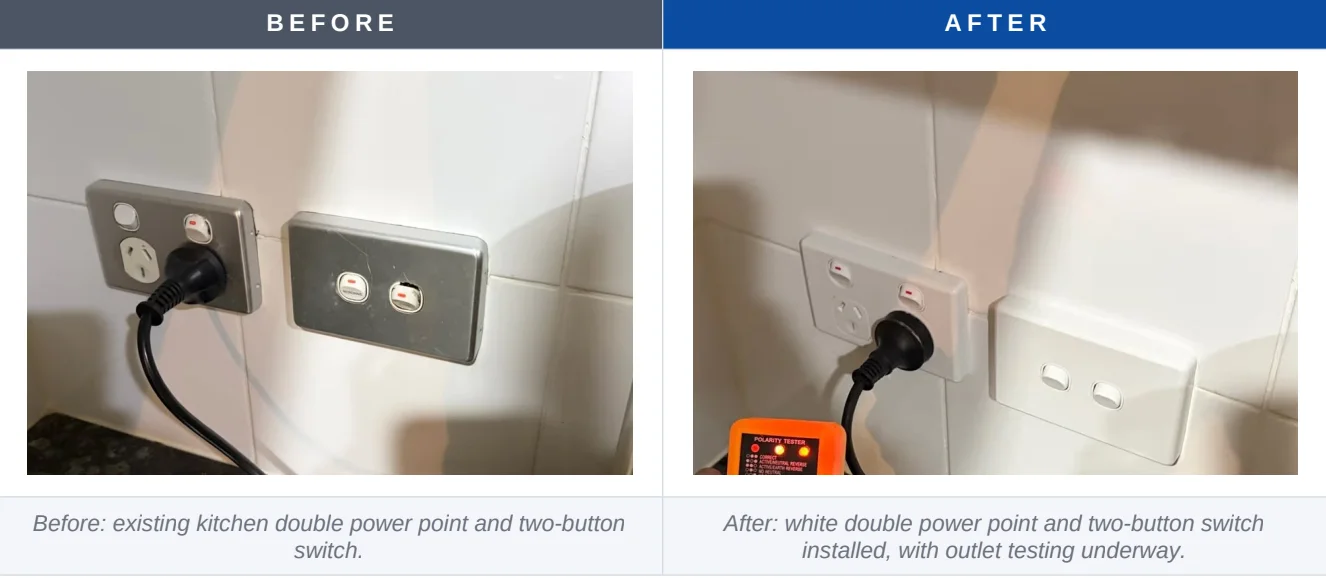 Nearby completed projectPower Point and Switch Replacement in Huntleys CoveA completed residential electrical repair involving a power point and switch.View the project →
Frequently Asked Questions
Does every older Ryde home need rewiring?
No. NSW recommends inspection of pre-1980s homes to identify aged or faulty wiring. The findings should determine the repairs required.
Can I tell whether wiring is safe by looking at the switchboard?
No. A switchboard assessment and an assessment of the wiring are related but different. NSW recommends professional inspection of older wiring and checking switchboard condition and safety-switch protection.
How often should I test safety switches?
Twice a year, following the relevant instructions. Contact an electrician if the test fails or a switch does not reset.
Can I replace a damaged power point myself?
Not unless appropriately qualified. NSW prohibits unqualified people from replacing or moving power points, lights and switches.
How long do smoke alarms last?
Fire and Rescue NSW recommends replacement at least every ten years, or earlier where specified by the manufacturer.
Does Russo Electrical service Ryde?
Yes. Russo Electrical advertises residential repairs, switchboard upgrades and emergency support in Ryde and surrounding suburbs.
Start with What You Know, and Have the Rest Checked
An effective electrical safety checklist does not require homeowners to diagnose faults or handle wiring.
It requires knowing where the protective devices are, testing them as instructed, maintaining smoke alarms, reporting damage and arranging professional assessment where the installation’s condition is uncertain.
For older Ryde homes, NSW guidance supports checking aged wiring and safety-switch coverage rather than assuming an installation is safe because it still works.
Russo Electrical provides local assessment, repairs and upgrade services. Use the checklist to explain your concerns, then let the inspection findings guide the work.
Electrical Safety and Maintenance Resources
NSW Government: Electrical safety in the home
Fire and Rescue NSW: Smoke alarms
For local assistance, visit our Ryde electrician page, switchboard upgrade service, or browse completed projects.