
Upgrading the wiring in a heritage home requires more than replacing old cables. It means improving electrical safety and capacity while respecting the features that make the property significant.
In Hunters Hill, that can involve planning around original finishes, decorative ceilings, masonry walls and visible external fittings. The electrical design and the proposed installation method both deserve attention.
Hunters Hill Council’s planning guidance states that alterations should respect the original building’s form, scale, architectural details, materials and finishes. The council also provides a heritage minor-works process for certain work to heritage items and properties in conservation areas.
For homeowners, the objective is balance: a safe, practical electrical installation delivered through a properly assessed, carefully planned scope.
Russo Electrical services Hunters Hill and surrounding suburbs, providing wiring assessments, switchboard upgrades, repairs and emergency electrical support. Its local service information recommends checking the switchboard, circuit capacity, consumer mains and earthing before major electrical upgrades.
This guide explains when wiring upgrades may be needed, how heritage considerations affect the process and what to discuss before work begins.
Why Heritage Homes May Need Electrical Upgrades
The age of a home does not establish the condition of its wiring.
A heritage property may already have a modern installation. Another may contain several generations of electrical work: original circuits, later additions and recent appliance connections.
That mixed history makes assessment more useful than assumptions.
NSW Government guidance recommends considering an electrical inspection for homes built before the 1980s to identify aged or faulty wiring. It warns that older rubber insulation can deteriorate and crumble, potentially exposing conductors.
The question is not simply, “Is this house old?” It is, “What is installed now, and is it safe and suitable for how the home is used?”
Common reasons to arrange an assessment
Discuss an inspection where:
NSW recommends professional assessment of older wiring and checking switchboard condition and safety-switch coverage. Russo Electrical’s local guidance also identifies capacity assessment as an important step before introducing major new electrical loads.
What Makes a Heritage Wiring Project Different?
The electrical requirements still apply, but the installation method may need additional planning.
A wiring route that is straightforward in an ordinary renovation may affect significant building fabric in a heritage property. Likewise, an external meter-box alteration may have a different visual impact from an internal fitting replacement.
Hunters Hill Council’s development controls emphasise respecting the original building’s architectural details, materials and finishes. New work should complement rather than visually compete with the building’s character.
Plan around what matters
Before finalising the electrical scope, identify features that should be protected. Depending on the property, these may include:
Do not assume “hidden work” is automatically unrestricted
Work behind a wall or ceiling can still affect building fabric.
Council’s heritage management guidance says the documentation required varies with the scope and significance of the work, and consultation may be needed to establish what applies.
The safest approach is to confirm the approval pathway rather than decide that an electrical job is too small to matter.
Check Heritage Status Before Finalising the Scope
A property can be individually heritage-listed, located within a heritage conservation area or affected by other planning considerations.
Hunters Hill Council identifies heritage items and conservation areas through its planning framework and provides guidance on the approvals required for heritage work.
Before booking non-urgent alterations:
Does a Wiring Upgrade Require Development Consent?
Not every project will require the same approval.
Hunters Hill Council states that development consent is not always needed for minor works to a heritage item or a property within a heritage conservation area. Under its minor-works process, an exemption letter must be issued by council in accordance with clause 5.10(3) of the Hunters Hill Local Environmental Plan 2012.
That is an important distinction: work being described as “minor” by a contractor or homeowner does not, by itself, establish an exemption.
What should you provide to council?
Ask what information is needed for your particular proposal. A clear project description might include:
What if the work is not exempt?
Council explains that projects which are neither exempt nor complying development require a development application. Heritage impacts can affect the available pathway.
Confirm the position for your property rather than relying on a generic rule.
Start with an Electrical Assessment, Not a Full-Rewire Assumption
A complete rewire may be necessary in some homes, but it should not be the default recommendation solely because a property is old.
An assessment should establish the condition of the installation and the extent of any defects.
NSW’s recommendation to inspect pre-1980s homes is intended to identify aged or faulty wiring. It does not state that every such property needs wholesale replacement.
Questions to ask the electrician
A useful assessment should help answer:
Partial Rewiring or Full Rewiring?
These are different project scopes, and the appropriate option depends on the findings.
A targeted upgrade
A targeted project may focus on a particular circuit, damaged section or area undergoing renovation.
Before agreeing to limited work, ask how it will connect to the remaining installation and what testing is included.
A broader replacement
Where deterioration or defects are more extensive, the electrician may recommend broader wiring replacement.
Ask why the proposed scope is necessary and how the work will be coordinated with heritage requirements, access and repairs to finishes.
In either case, fixed wiring alterations must be undertaken by an appropriately licensed professional. NSW warns that unqualified people must not wire a property or undertake electrical maintenance.
Switchboard Upgrades: Improve Protection Without Ignoring the Rest of the Home
A switchboard upgrade can be an important part of a heritage-home project, but it is not a substitute for checking the wiring it supplies.
NSW Government guidance distinguishes between:
| Device | Main purpose |
|---|---|
| Circuit breaker | Protects circuitry and wiring |
| Safety switch, or RCD | Helps protect people from severe electric shock by detecting current leakage |
Some devices combine these functions. The electrician should explain the proposed protection rather than relying on a list of unfamiliar product names.
Check safety-switch coverage
Finding one safety switch does not confirm that every circuit is protected.
NSW notes that older houses may have a single safety switch protecting several circuits. It recommends asking an electrician whether the home has appropriate coverage.
Consider the switchboard’s location
Where the project changes an external enclosure or another visible element, include that alteration in the heritage discussion.
Council’s planning guidance asks that changes respect the building’s materials, architectural details and finishes. The proposed enclosure, position and associated work should therefore be considered as part of the overall project.
Russo Electrical advertises switchboard upgrades for Hunters Hill and nearby suburbs and recommends assessing consumer mains and earthing alongside circuit capacity.
Plan Cable Routes Before Opening Walls
In a heritage home, the route can matter as much as the destination.
Before installation, ask the contractor to explain:
The route needs to satisfy electrical requirements and the agreed heritage approach. Council’s controls emphasise respecting the original building, while its heritage-document guidance makes the significance and scope of work relevant to the assessment.
Include making good in the quote
Clarify whether the electrical contractor’s price includes:
Upgrading Lighting While Retaining Character
A lighting upgrade can involve replacing damaged equipment, improving illumination or adapting significant fittings for continued use.
Start by distinguishing the decorative element from the electrical components. If a fitting has heritage significance, seek advice before altering or discarding it.
Any electrical repair or hardwired replacement still requires appropriately qualified work. NSW prohibits unqualified people from installing, replacing or moving lights and switches.
Explain faults before choosing replacements
Tell the electrician if an existing light:
Prepare for Modern Appliances Without Overbuilding
Heritage character does not prevent a home from accommodating modern electrical equipment. However, appliance upgrades should be planned around the installation’s actual capacity.
Russo Electrical’s local guidance recommends checking switchboards, circuit capacity, consumer mains and earthing before installing systems that may require an upgrade.
Provide specifications for proposed equipment such as:
Can the Work Be Staged?
Staging may help with budgeting and access, but the electrician must determine whether the proposed sequence is appropriate.
A useful plan separates:
What Should a Heritage Wiring Quote Include?
A meaningful quote should describe the work, not just say “rewire heritage house”.
Ask for clarity on:
What If a Fault Requires Urgent Attention?
Planning a heritage upgrade should never mean ignoring an immediate electrical hazard.
If there is smoke or fire, leave the affected area and call 000. Keep clear of wet, damaged or exposed electrical equipment.
NSW warns against touching old wiring because exposed live conductors may be present. It also advises contacting a licensed electrician if a safety switch does not reset.
For urgent electrical work, explain the property’s heritage status and the immediate problem. Ask the contractor to make the situation safe and document what was found, while obtaining council advice for subsequent alterations where required.
Russo Electrical advertises 24/7 emergency support for Hunters Hill and surrounding Lower North Shore suburbs. Confirm availability and charges directly when calling.
Maintain the Installation After the Upgrade
Once the work is complete, retain a clear record of the installation.
Keep:
How Russo Electrical Can Help Hunters Hill Homeowners
For local electrical assessments, switchboard work and repairs, see our Hunters Hill electrician service page.
Russo Electrical services Hunters Hill, Woolwich and nearby suburbs with repairs, switchboard upgrades, safety inspections and emergency electrical work. Its local guidance addresses wiring condition, earthing, safety switches and capacity for modern appliances.
For a heritage property, begin with:
Nearby Electrical Upgrade Projects
These are completed Russo Electrical projects in nearby Woolwich and Gladesville, not documented heritage wiring projects in Hunters Hill. They illustrate careful lighting work and switchboard improvements.
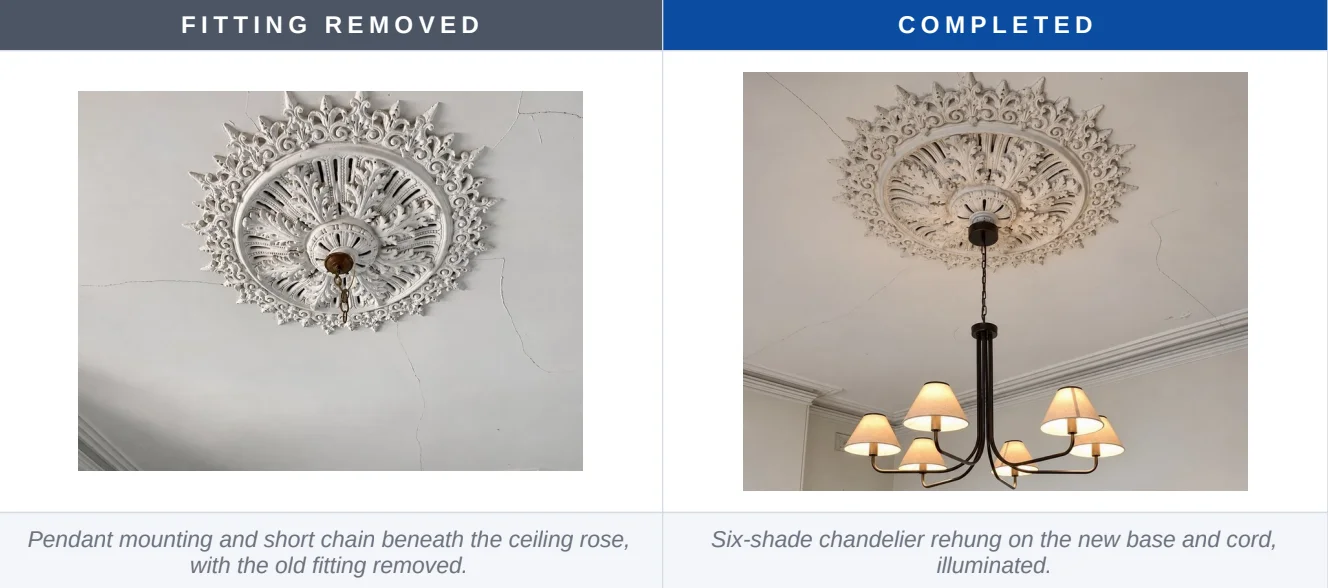 Nearby Woolwich projectPendant and Basement Lighting in WoolwichAn existing six-shade chandelier was rehung beneath its ornate ceiling rose with a new client-supplied base and cord; basement lights and power points were also installed.View project →
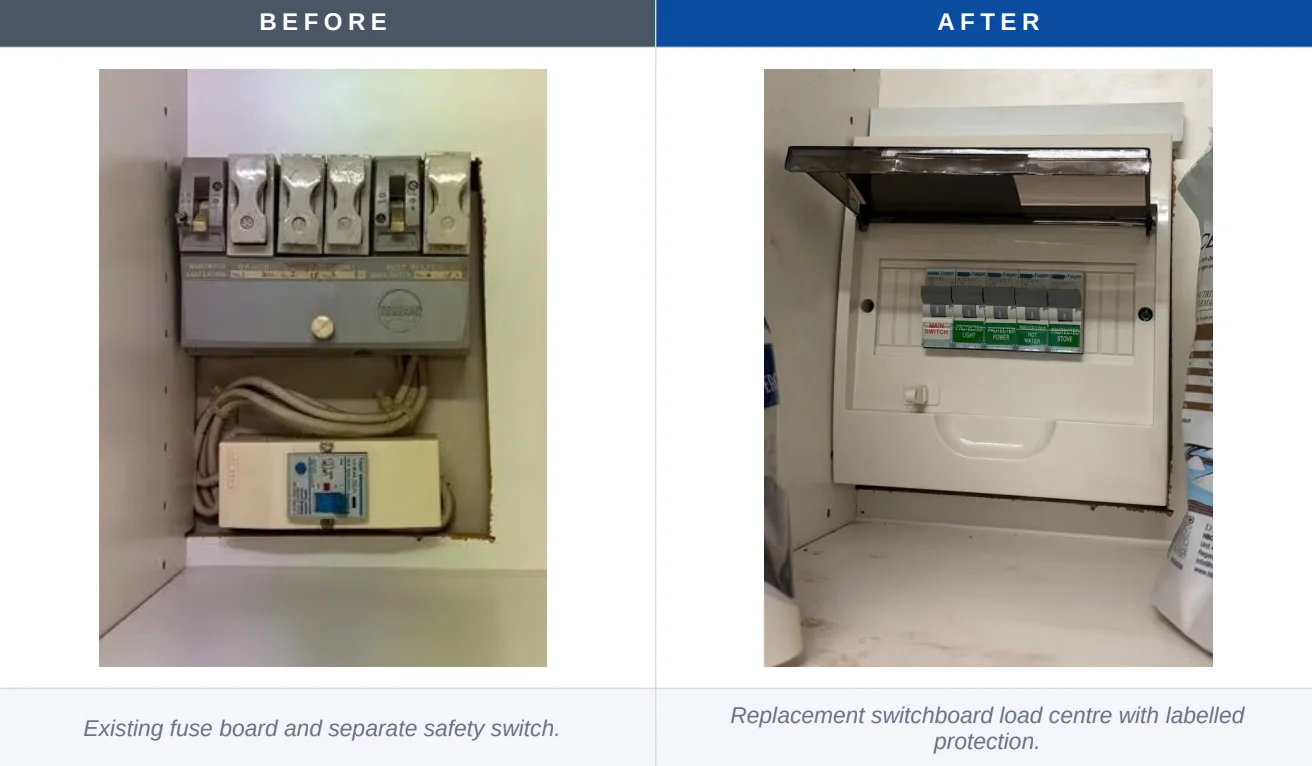 Nearby Gladesville projectSwitchboard Load Centre Upgrade in GladesvilleAn example of upgrading an older fuse-based switchboard with new protective devices.View project →
Frequently Asked Questions
Does every heritage home need rewiring?
No. NSW recommends assessment of older wiring, particularly in pre-1980s homes. The condition and test findings should determine the scope.
Does electrical work always require a development application?
No. Hunters Hill Council provides a minor-works pathway for certain heritage work, but the exemption requires council’s written determination under the relevant process. Confirm the pathway before starting.
Can I replace old switches myself to retain the original appearance?
Not unless appropriately qualified. NSW prohibits unqualified people from replacing power points, lights and switches. Discuss conservation and electrical requirements with the relevant professionals.
Can a new switchboard solve all old-wiring problems?
No. Switchboard condition, circuit protection and wiring condition are related but separate matters. NSW recommends checking both older wiring and protective equipment.
Can modern appliances be installed in a heritage home?
They may be accommodated, but the electrical capacity, installation requirements and any affected building fabric need assessment. Russo Electrical recommends checking the supply and circuits before major upgrades.
Who decides whether heritage approval is needed?
Confirm the planning pathway with Hunters Hill Council. Electrical licensing and planning approval are separate requirements. Council publishes both minor-works and broader approval guidance.
Upgrade the Installation While Respecting the Home
A well-planned wiring upgrade begins with evidence: the condition of the electrical installation, the needs of the household and the significance of the building fabric.
For Hunters Hill heritage properties, that means coordinating professional electrical assessment with the appropriate council pathway. Do not assume that every old home needs a complete rewire, or that minor-looking work is automatically exempt from approval.
Russo Electrical provides local electrical assessment, repairs and upgrade services. A clear scope, appropriate approvals and agreed protection of finishes help turn the project into a practical improvement rather than an avoidable disruption.
Heritage and Electrical Safety Resources
NSW Government: Electrical safety in the home
Hunters Hill Council: Heritage advice, minor works and planning approval information
Learn about Russo Electrical’s Hunters Hill electrician services, switchboard upgrades and completed case studies.