
Outdoor lighting, power points and garden equipment help make a home more comfortable and practical. They illuminate entrances, support outdoor entertaining and supply power where it is needed.
But outdoor electrical fittings face conditions that indoor equipment does not: rain, irrigation, damp ground, garden maintenance and accidental damage. Even a fitting installed under a roof may be exposed to wind-driven rain or cleaning water.
For Tennyson Point homeowners, protecting outdoor electrical equipment starts with choosing fittings suited to their location, keeping connections protected and arranging repairs when damage appears.
Australian electrical safety guidance recommends weatherproof power points and switches where exposure to the elements is likely. It also advises using outdoor-rated leads and power boards, protecting connections from weather and using safety-switch-protected circuits for outdoor equipment.
The key is suitability. A fitting must suit its actual exposure and intended use, not simply carry an “outdoor” label.
Russo Electrical provides electrical services in Tennyson Point, including residential repairs, lighting, switchboards and emergency work. Its broader residential services include outdoor lighting, power points, safety-switch testing and fault finding.
What Counts as an Outdoor Electrical Fitting?
When reviewing your outdoor electrical setup, think beyond the light beside the back door.
Equipment worth including in the discussion with your electrician may include:
Not every item has the same installation or maintenance requirements. Fixed wiring, portable equipment and self-contained solar lights are different categories, so the appropriate response depends on the product and the work involved.
For permanent lighting, power points and wiring, NSW requires electrical installation work to be carried out by a licensed electrician.
1. Start with the Conditions Around Each Fitting
A fitting’s location affects what protection it needs.
Rather than asking only whether it is “weatherproof”, consider how water, garden work and normal household activity could affect it.
Walk around the property and note:
Electrical Safety Office guidance specifically identifies rain and sprinkler splash as exposures to consider when using outdoor power boards. It also warns about leads being cut or damaged during gardening.
A covered area is not automatically a dry area
An alfresco roof may reduce direct rainfall without eliminating exposure from the side, nearby irrigation or cleaning.
Do not assume an indoor fitting becomes suitable simply because it sits under cover. Have the electrician assess the position and select equipment intended for those conditions. Weatherproof outlets and switches are recommended where exposure to the elements is likely.
2. Understand What an IP Rating Does, and Does Not, Tell You
Many outdoor electrical products display an ingress protection, or IP, rating.
The first digit describes protection against solids and dust. The second describes protection against water. These ratings distinguish different types of exposure rather than giving a blanket promise that water cannot cause damage.
| Rating | General protection described | Important limitation |
|---|---|---|
| IP44 | Objects larger than 1 mm and water splashes | Not an immersion rating |
| IP65 | Dust-tight protection and resistance to water jets | Does not establish suitability for submersion |
| IP67 | Dust-tight protection and temporary immersion under specified conditions | Not automatic approval for permanent underwater use |
These examples explain the rating system; they are not a universal specification for every outdoor installation. The appropriate product depends on its intended application, installation requirements and exposure.
Check the complete product
Ask whether the published rating applies to the whole assembly, including any connectors, controls or power-supply components.
Also ask whether the protection changes when a plug is inserted or a cover is open. Follow the manufacturer’s installation and operating instructions rather than relying on the number alone.
Do not assume rain resistance means pressure-washer resistance
Splashing, water jets and immersion are different categories of exposure. A product’s rating should not be interpreted as approval for any cleaning method.
Use the manufacturer’s cleaning instructions and avoid directing water at electrical fittings unnecessarily.
3. Protect Outdoor Power Points and Plug Connections
A suitable wall outlet is only one part of a safe arrangement. The plug, lead, appliance and any intermediate connection also need to suit their use.
Electrical safety guidance recommends protecting outdoor connections from weather and ensuring equipment is suitable for the intended application. Energex specifically warns against exposing extension-lead joins to the weather.
Check how the outlet is used
Discuss the following with your electrician:
Avoid improvised covers
Do not assume a plastic bag, tape or household container provides an appropriate weatherproof connection.
Ask the equipment supplier or electrician about a purpose-designed arrangement and follow its instructions. The objective is to use equipment as intended, not simply hide the connection from view.
4. Confirm Safety-Switch Protection
A safety switch, also called a residual current device or RCD, helps protect people from severe electric shock by detecting current leakage and disconnecting power.
Electrical Safety Office guidance recommends using a safety-switch-protected circuit when operating outdoor equipment.
A circuit breaker is different
NSW Government guidance explains:
Circuit breakers protect circuitry and wiring.
Safety switches help protect people from severe electric shock.
Some devices combine these functions, but homeowners should not assume every switch offers both forms of protection.
Check coverage, not just presence
A safety switch protects the circuits connected through it. Finding one in the switchboard does not confirm protection for every outdoor outlet or fitting.
NSW recommends asking an electrician whether the home has appropriate safety-switch coverage, particularly where an older installation has limited protection.
When booking outdoor work, ask specifically which circuits supply the equipment and whether their protection is suitable.
5. Maintain Safety Switches on a Regular Schedule
NSW recommends testing household safety switches twice a year.
For safely accessible devices, follow the manufacturer’s instructions and government guidance. Let everyone in the home know before testing because the relevant circuits should lose power.
Contact a licensed electrician if:
6. Keep Garden Maintenance Away from Electrical Equipment
Gardening tools and electrical leads need careful separation.
Electrical Safety Office guidance warns about accidental damage from electric mowers, line trimmers, hedging tools and other equipment. It recommends heavy-duty outdoor leads and awareness of their position while working.
Before starting a gardening task:
Make permanent fittings easy to observe
When planning planting or storage, consider whether you will still be able to see and access fittings.
A practical maintenance check depends on being able to notice a cracked cover, loose enclosure or other visible change. Avoid treating electrical equipment as something to conceal and forget.
7. Use Extension Leads Carefully, and Temporarily
An extension lead can support a task, but it should not become an unexamined permanent feature of the garden.
Use leads intended for the task and outdoor conditions. Protect joins from weather, and avoid routes where vehicles or equipment could damage them. Energex advises against laying extension leads across driveways.
If you frequently run a lead from indoors to the same outdoor location, discuss a permanent outlet with an electrician.
Russo Electrical provides additional power points, dedicated circuits and circuit alterations. The assessment should consider both the outlet position and the circuit supplying it.
Do not add adaptors and boards indefinitely to compensate for an unsuitable layout.
8. Take Water Exposure and Wet-Weather Faults Seriously
If a light or outlet behaves differently after rain, record the pattern and arrange advice.
Useful details include:
Power returning does not confirm a repair
A fault disappearing temporarily does not establish what caused it or whether equipment is undamaged.
Keep clear of wet electrical equipment. Australian government guidance warns against using portable appliances, tools and extension leads in water or rain.
If there is smoke or fire, leave the affected area and call 000. Do not approach equipment to investigate.
9. Recognise Visible Warning Signs
Include outdoor fittings in a simple visual inspection. Do not open them.
Seek advice about:
Do not repair enclosures with household materials
If a seal, cover or enclosure is damaged, ask about approved replacement parts or fitting replacement.
Tape or sealant should not be assumed to restore the product’s original protection. Obtain advice from the manufacturer or electrician rather than modifying the fitting.
10. Treat Pools and Water Features as Separate Design Situations
A fitting suitable for a general garden area is not automatically appropriate beside a pool or inside a water feature.
Electrical safety guidance warns against using leads near outdoor wet areas unless they are specifically designed for external use, and against operating portable equipment in water or rain.
For permanent equipment, have an electrician assess the location and installation requirements.
Do not choose a position using a generic distance found online. Likewise, an IP67 rating for temporary immersion does not make an ordinary garden light a permanent underwater fitting.
11. Arrange Professional Work Before an Outdoor Renovation Is Finished
Outdoor renovations are easier to coordinate when electrical requirements are discussed early.
Before completing paving, cabinetry or landscaping, describe:
Russo Electrical offers outdoor lighting, controls, power points and circuit work. Its published process begins with reviewing the homeowner’s information and arranging an inspection where required before explaining the scope.
Early planning does not eliminate every surprise, but it helps identify electrical requirements before finishes restrict access.
12. Use Licensed Electricians and Keep the Records
Installing, replacing or relocating outdoor power points, lights and fixed wiring is not a DIY task.
NSW warns that unqualified people must not replace power points, lights, switches or undertake fixed electrical maintenance. DIY electrical work can cause injury, death or fire and affect insurance.
Before agreeing to work:
NSW states that electrical installation work must be supported by a uniquely numbered Certificate of Compliance for Electrical Work demonstrating that it has been tested and complies with regulations.
Keep that paperwork with the invoice, product manuals and warranty information.
Outdoor Electrical Maintenance Checklist
| Item | What to review |
|---|---|
| Fitting selection | Appropriate for the location and exposure |
| Covers and enclosures | No visible cracks, looseness or damage |
| Plug connections | Protected according to the product requirements |
| Safety switches | Relevant circuits protected and devices tested twice yearly |
| Leads | Suitable for outdoor use, undamaged and safely routed |
| Irrigation | Not creating unsuitable exposure |
| Drainage | No recurring pooling around equipment |
| Cleaning | Carried out according to manufacturer instructions |
| Fault history | Recurring trips or wet-weather problems reported |
| Permanent alterations | Completed by a licensed electrician |
This checklist helps organise observations. It does not replace inspection or testing of the installation.
How Russo Electrical Can Help Tennyson Point Homeowners
Our Tennyson Point electrician page covers locally available residential services.
Russo Electrical advertises residential and emergency electrical services in Tennyson Point. Its broader service offering includes:
Ask the team to confirm availability, call-out charges, diagnostic rates and the scope before booking. Do not assume a decorative lighting quote includes investigation of an existing wiring fault.
Related Electrical Projects in Tennyson Point
Explore five completed Tennyson Point case studies covering outdoor lighting, light switches, ventilation, lighting repairs and bathroom fittings. A nearby Longueville weatherproof-switch project is also included.
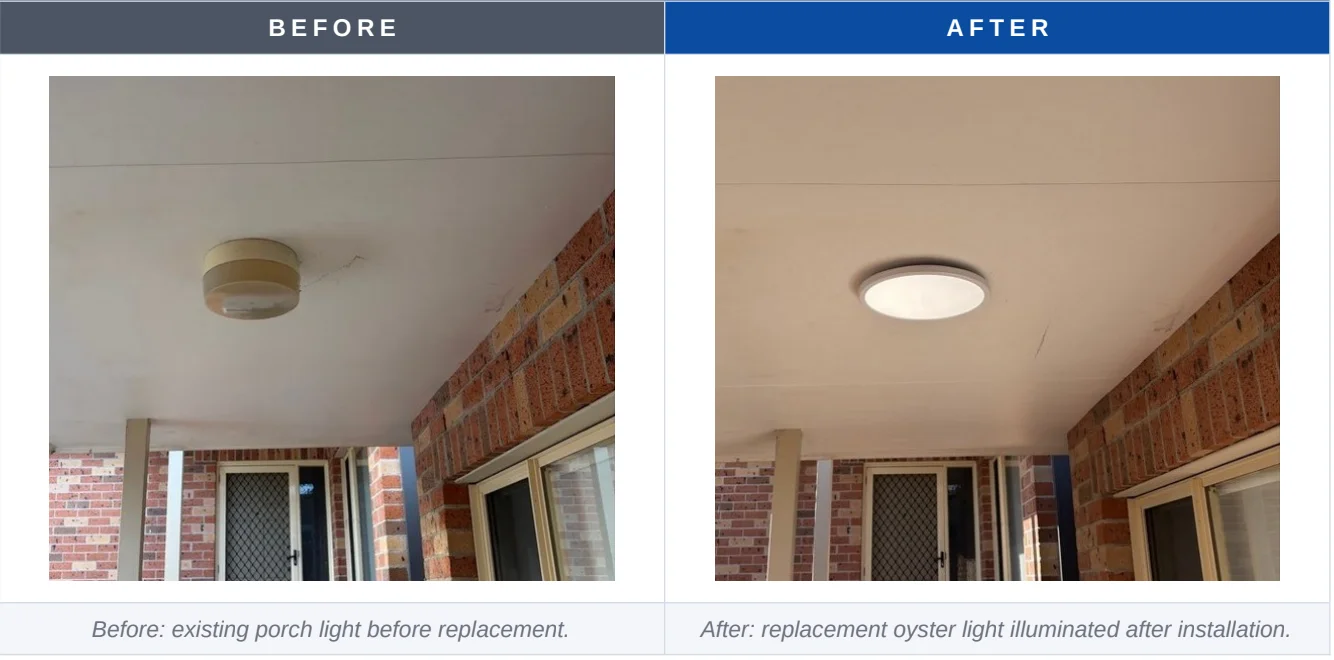 Local Tennyson Point projectPorch Light Replacement in Tennyson PointAn example of exterior entrance lighting replacement in Tennyson Point.View project →
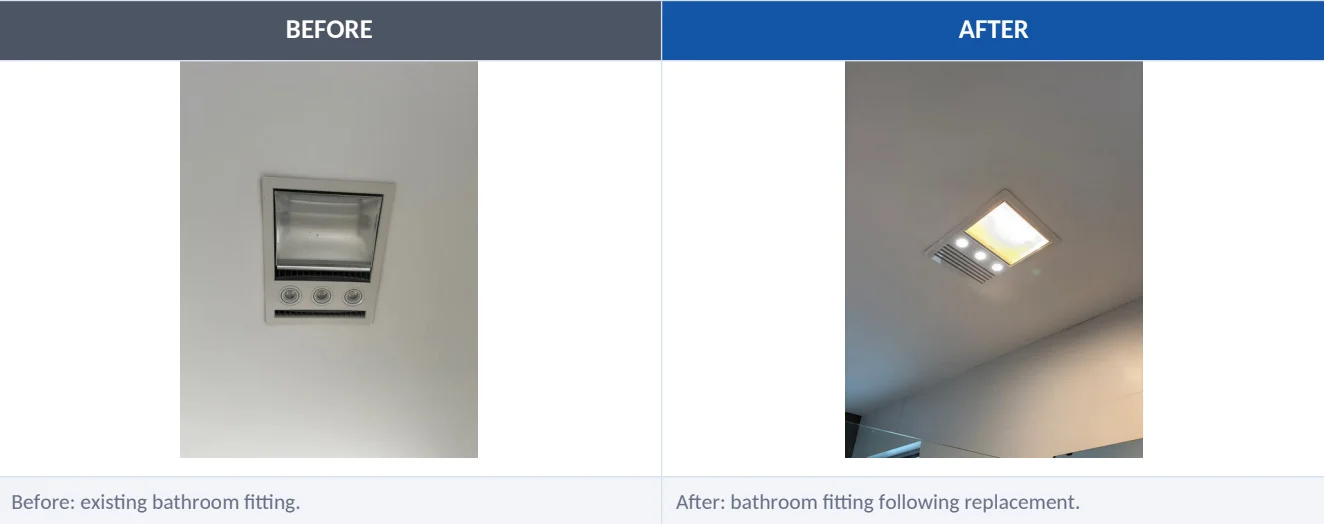 Local Tennyson Point projectExhaust Fan Replacement in Tennyson PointA completed replacement of a ventilation fan at a Tennyson Point home.View project →
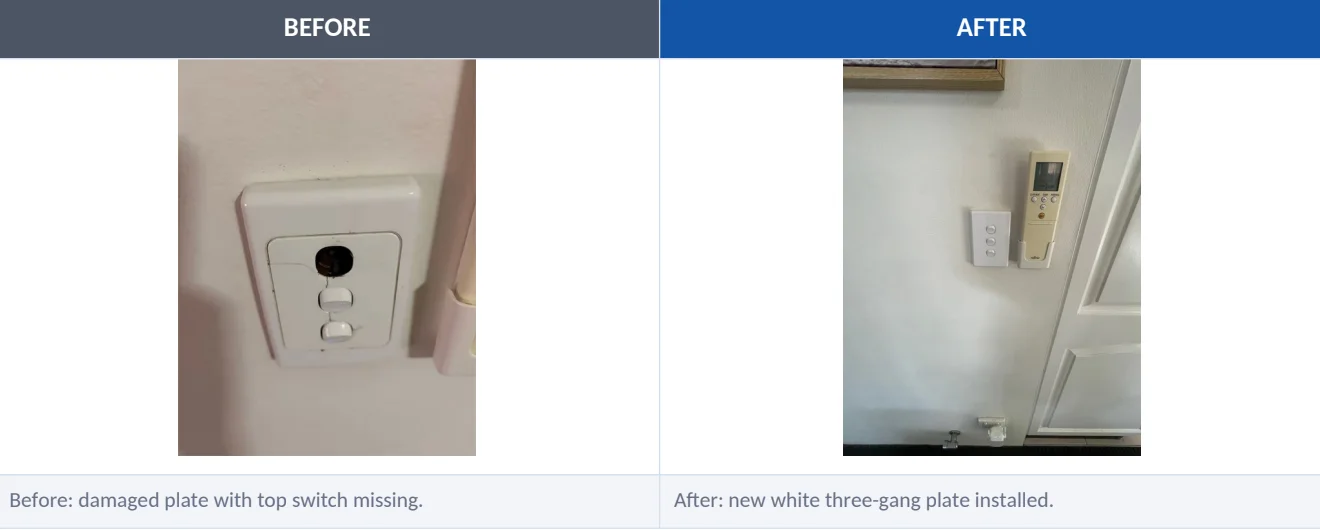 Local Tennyson Point projectLight Switch Replacement in Tennyson PointBefore-and-after photos of a residential light switch replacement.View project →
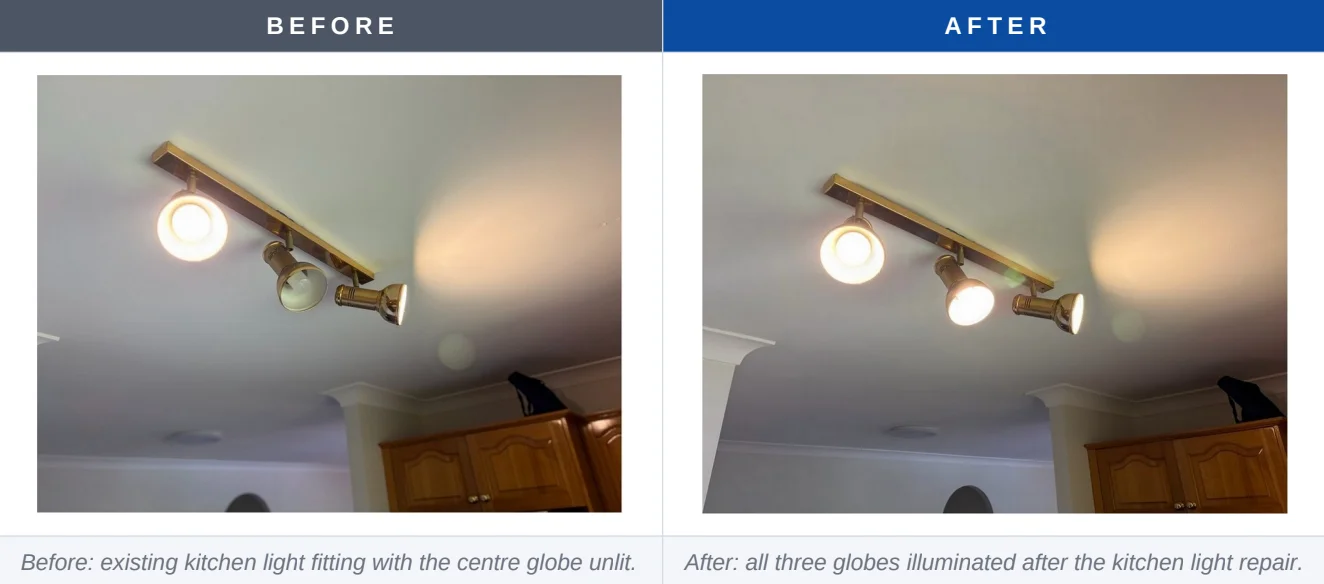 Local Tennyson Point projectLighting Repairs in Tennyson PointA completed local lighting repair shown with original project photographs.View project →
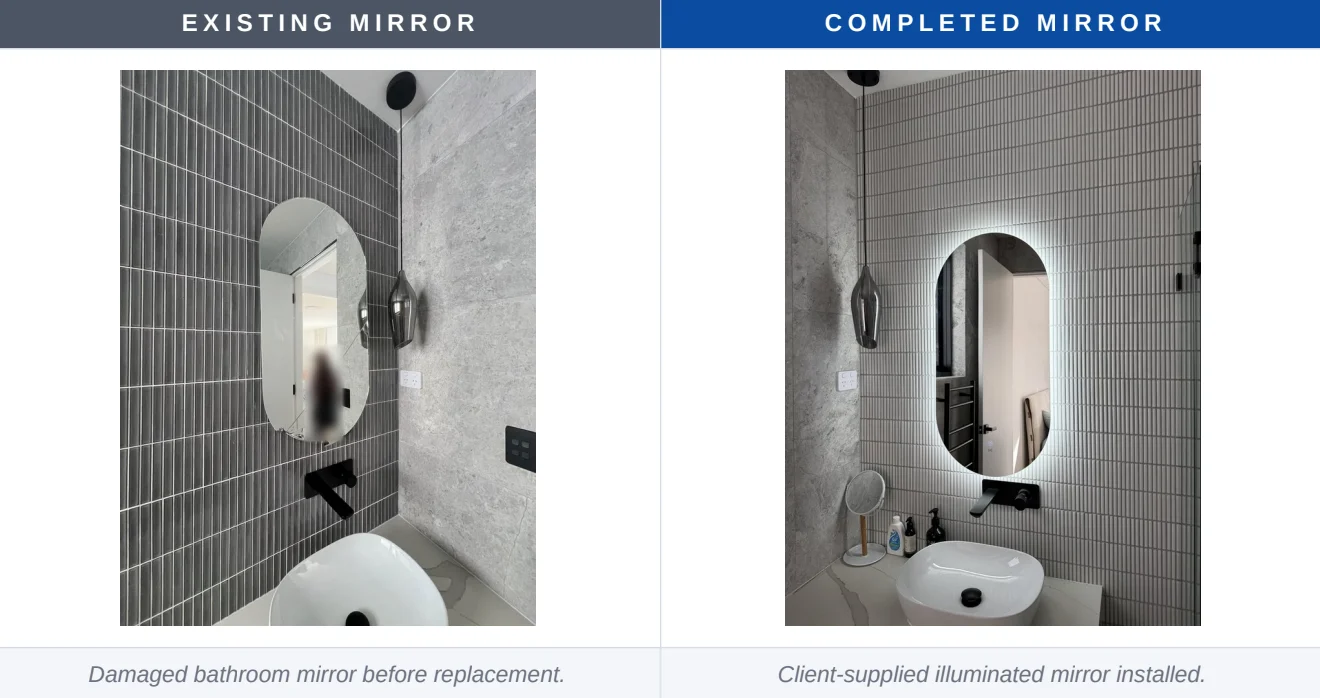 Local Tennyson Point projectBathroom Mirror Replacement in Tennyson PointA client-supplied illuminated bathroom mirror installed in Tennyson Point.View project →
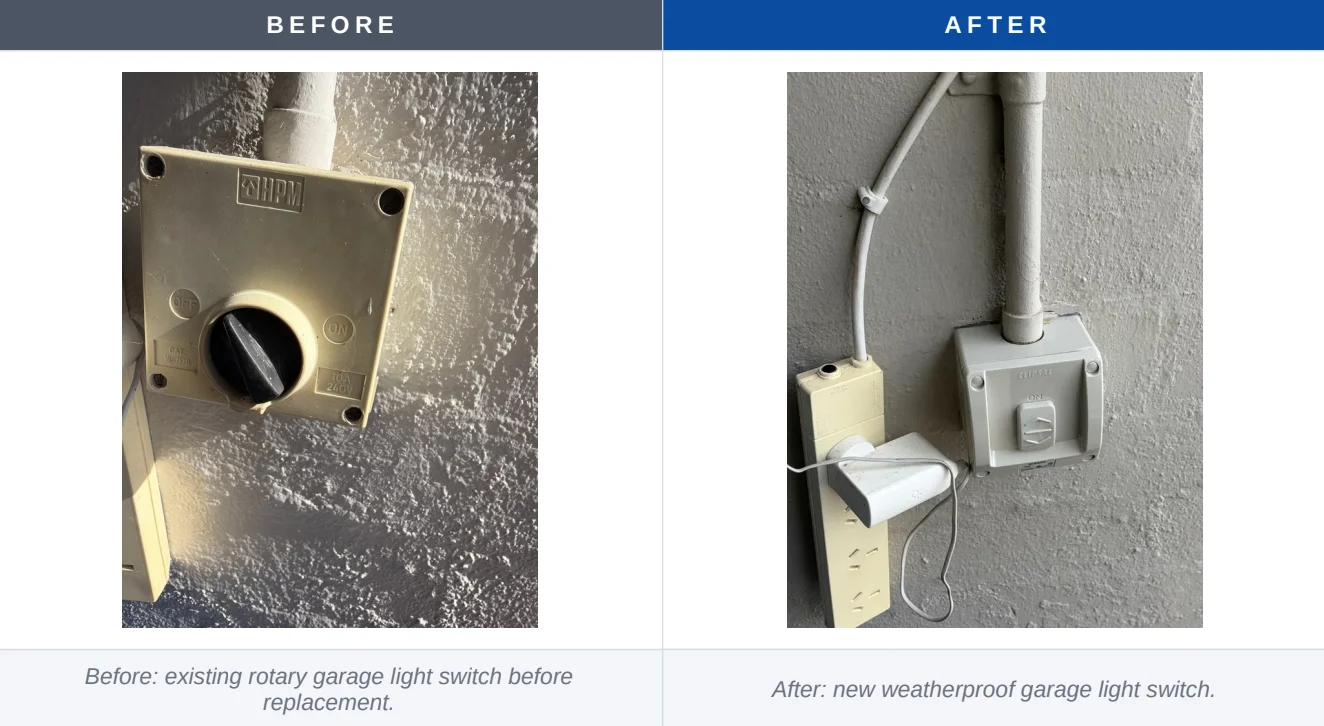 Nearby Longueville projectWeatherproof Garage Light Switch Replacement in LonguevilleA nearby example of replacing a weatherproof garage switch fitting.View project →
Frequently Asked Questions
Are all outdoor fittings waterproof?
No. Products offer different levels of ingress protection and have different installation conditions. Check the rating and manufacturer’s instructions.
Is an outlet under a patio roof protected enough?
Not necessarily. Consider wind-driven rain, irrigation and cleaning exposure. Weatherproof outlets are recommended where fittings may be exposed to the elements.
Can I hose down outdoor electrical fittings?
Do not assume so. Follow the manufacturer’s cleaning instructions. A water-protection rating is not unrestricted approval for every cleaning method.
How often should I test safety switches?
NSW recommends twice a year. Contact a licensed electrician if testing fails or the device does not reset.
Can I replace a broken outdoor light myself?
Not unless appropriately qualified. NSW prohibits unqualified people from installing, replacing or moving lights and switches.
What if a fitting stops working after rain?
Keep clear of wet equipment and arrange assessment. Do not repeatedly reset a safety switch that will not stay on or assume the fault is repaired when operation returns.
Does Russo Electrical service Tennyson Point?
Yes. Russo Electrical publishes a Tennyson Point service page and offers residential repairs, installations and emergency work.
Protect the Whole Outdoor Electrical Setup
Outdoor electrical safety depends on more than a weatherproof cover.
The fitting, connection, circuit protection, equipment and surrounding conditions all need consideration. Keep leads away from gardening tools and wet areas, maintain safety switches and report visible damage or recurring faults.
For Tennyson Point homeowners planning repairs or upgrades, Russo Electrical provides local electrical services and outdoor lighting support. A clear description of the location and exposure helps the team assess what is appropriate for the property.
Electrical Safety and Local Resources
NSW Government: Electrical safety in the home
Further general guidance on outdoor leads, water exposure and IP ratings is available from the Queensland Electrical Safety Office, Energex, RS DesignSpark and LEDVANCE. Advice from outside NSW is general safety guidance rather than NSW installation law.
Explore Tennyson Point electrical services and completed case studies.