
Most EV owners in Australia do the bulk of their charging at home. You plug in when you park and wake up to a charged battery. But a home charger adds a large, long-running load to your electrical system, so the installation deserves as much thought as the charger itself.
The short version
- A wall charger is the usual choice: a 7 kW single-phase wallbox can refill most EVs overnight. A portable charger on a standard power point is slow but useful as a backup.
- Check capacity before you buy: a licensed electrician assesses your switchboard, supply and existing loads first.
- It needs its own circuit: a wall charger runs on a dedicated circuit with the right cable, protection and isolation.
- Distance and route drive the price: the cable run from your switchboard to the parking spot is a big part of the cost.
- Compliance matters: in NSW, your electrician tests the work and lodges a Certificate of Compliance for Electrical Work (CCEW).
- Hire a licensed electrician: it protects your safety, your home insurance and the charger warranty.
Why home charging beats public stations
Home charging wins on convenience. You skip the detours, the waiting and the guesswork about whether a public charger is working or free.
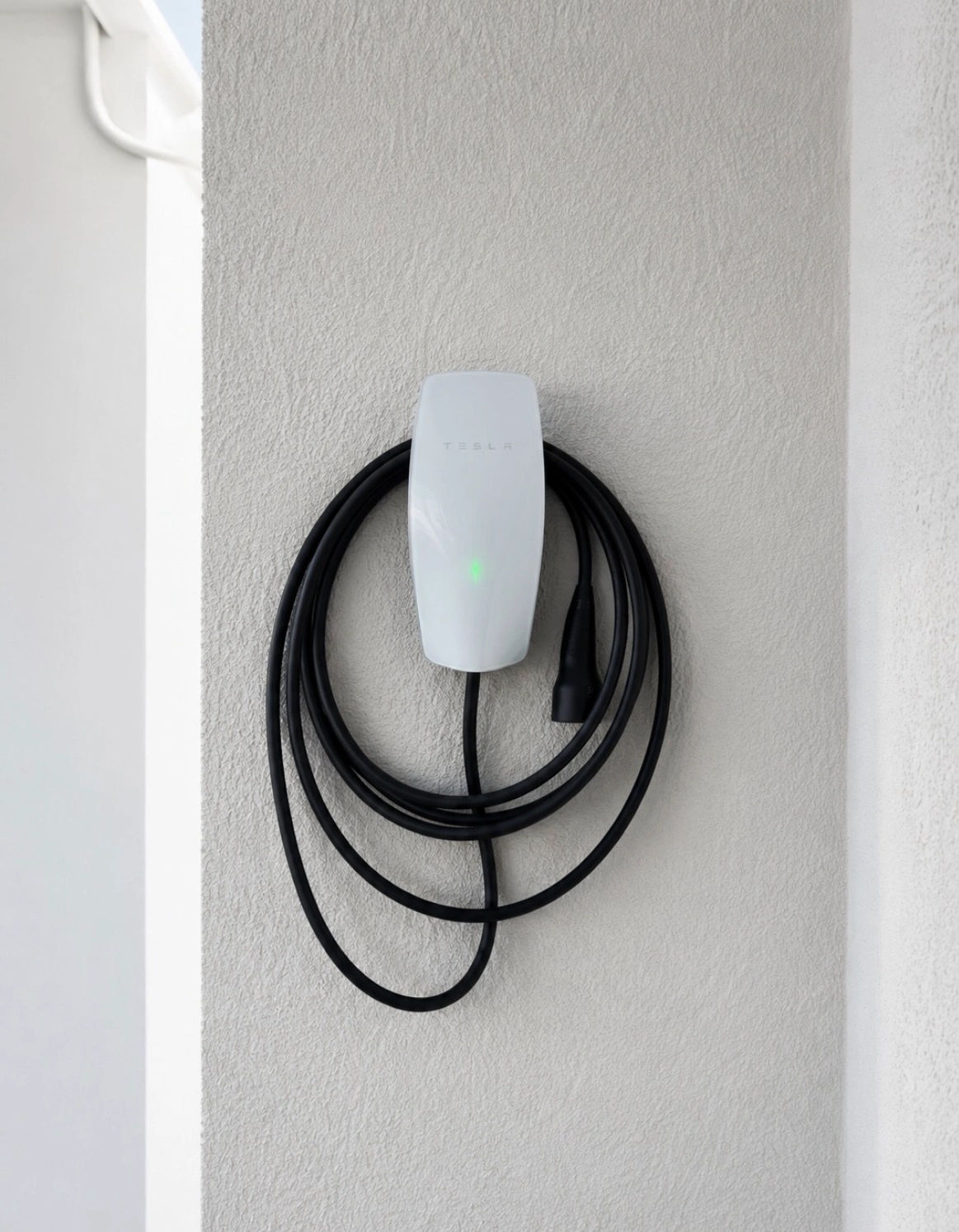
A wall-mounted charger is the usual choice for home. It can fully charge most electric vehicles overnight.
Why installation is not a plug-and-play job
Installing a charger adds a serious electrical load to your home. Three questions come first:
- Can your switchboard and supply handle the added demand?
- Do you need a new dedicated circuit for the charger?
- Will the installation meet the AS/NZS 3000 Wiring Rules and NSW requirements?
Mistakes here can cause overheating, nuisance tripping or worse. A licensed electrician with EV charger experience answers these questions before any cable is run.
Types of home EV chargers
Home charging comes down to three choices: the power level, how the unit connects to your wiring, and how many smart features you want. Each choice affects cost, speed and the electrical work required.
Portable charger versus wall charger
A portable charger (often supplied with the car) plugs into a standard 10 amp power point. It is the slowest option, adding roughly 10 to 15 km of range per hour.
A wall charger (wallbox) is fixed to the wall on its own circuit. A typical 7 kW single-phase unit adds roughly 40 to 50 km of range per hour. Homes with three-phase power can use faster chargers if the car supports them.
| Feature | Portable charger | Wall charger |
|---|---|---|
| Connection | Standard 10 amp power point | Dedicated circuit, usually hardwired |
| Typical power | About 2.3 kW | 7 kW single-phase, or more on three-phase |
| Range added per hour | Roughly 10 to 15 km | Roughly 40 to 50 km at 7 kW |
| Electrical work | Often none, but the circuit should be checked | New circuit, protection and isolation |
| Best for | Short daily trips and backup use | Most daily drivers and multi-EV homes |
A portable charger suits drivers with short daily trips and a full night of parking. It also works as a backup when you travel. If you drive longer distances or share one home between several EVs, a wall charger is the practical fit. The trade-off is the installation work it requires.
Single-phase or three-phase?
Most Sydney homes have single-phase power, and a 7 kW wall charger is the common choice. Three-phase power can support faster home charging, but only if your car can accept it and the supply has the capacity. Faster is not always necessary: most drivers can replace their normal daily travel overnight at 7 kW. Our guide Does my home have enough electrical capacity? explains the trade-offs.
Smart chargers and Wi-Fi features
Many wall chargers connect to your home Wi-Fi. A smart charger adds control that a basic unit lacks. Common features include:
- Scheduling charging for off-peak or cheaper tariff times
- Charging from surplus rooftop solar
- Load management that reduces charging when the home is using more power
- Tracking energy use and starting or stopping a session from an app
Scheduling and load management are the features most likely to save you money, and load management can sometimes avoid a supply upgrade. Smart features need a reliable Wi-Fi signal where the charger is mounted, so settle that before installation day.
Checking whether your home is ready
Before you buy a unit, confirm your home can support it. Three checks decide most projects: switchboard and supply capacity, a dedicated circuit, and the distance from the switchboard to your parking spot.
Switchboard capacity and maximum demand
Your switchboard and supply have a fixed amount of power to share. A wall charger asks for a large portion of it, and it may run for hours at a time.
A licensed electrician assesses your existing loads, such as air conditioning, cooking and hot water, and compares them with what the supply can safely carry. The result points to one of two outcomes:
- There is enough spare capacity, and the charger can be added as is.
- The installation is near its limit, and you need a switchboard upgrade, load management or a different solution.
Older Sydney homes are more likely to fall into the second group, especially those with ceramic fuses or no spare space on the board.
A dedicated circuit
A wall charger needs its own circuit. It cannot share a circuit with other power points or appliances. A dedicated circuit protects the wiring from overload and stops the charger tripping when other loads switch on. The electrician typically confirms that:
- The circuit breaker and safety switch (RCD) suit the charger's rating
- The cable size can carry the load continuously without overheating
- The charger has suitable isolation and is rated for continuous use
- There is space on the switchboard for a new circuit
Distance from switchboard to parking spot
The path between your switchboard and your charger affects both cost and difficulty. A short run through an open garage wall is the simplest case. Longer runs need more cable, more labour and sometimes larger cable to keep performance steady over the distance.
| Situation | What it means for installation |
|---|---|
| Switchboard and parking spot in the same garage | Short cable run, usually the simplest job |
| Switchboard on the opposite side of the house | Longer run through walls, roof space or subfloor |
| Carport, driveway or detached garage | Possible trenching, outdoor-rated equipment and conduit |
Walk from your switchboard to your parking spot and note any obstacles, such as finished walls, concrete or landscaping. Share those details with your electrician early. A clear picture of the route leads to a more accurate quote and fewer surprises on installation day.
The installation process, step by step
A typical home EV charger installation follows the same order every time. Knowing the sequence helps you spot a careful installer and plan around the work.
Site assessment and written quote
The job starts with a visit. Your electrician looks at the switchboard, the parking spot and the route between them, and assesses the capacity. During the visit, expect the electrician to:
- Inspect the switchboard for spare space and overall condition
- Measure the cable run from the switchboard to the charger location
- Check for finished walls, concrete or landscaping in the way
- Review your charger choice, its rating and where it will mount
Ask for a detailed written quote before any work begins. It should separate the charger, labour, materials and any switchboard work so you can compare quotes line by line. Check credentials at this stage too: a legitimate electrician will show a current NSW contractor licence and proof of insurance without hesitation.
Running the cable and mounting the charger
Once the quote is approved, the physical work begins. The electrician isolates the power, installs protection for the new dedicated circuit, and runs the cable through walls, roof space, subfloor or conduit. For carports and detached garages, the cable may need trenching and outdoor-rated conduit.
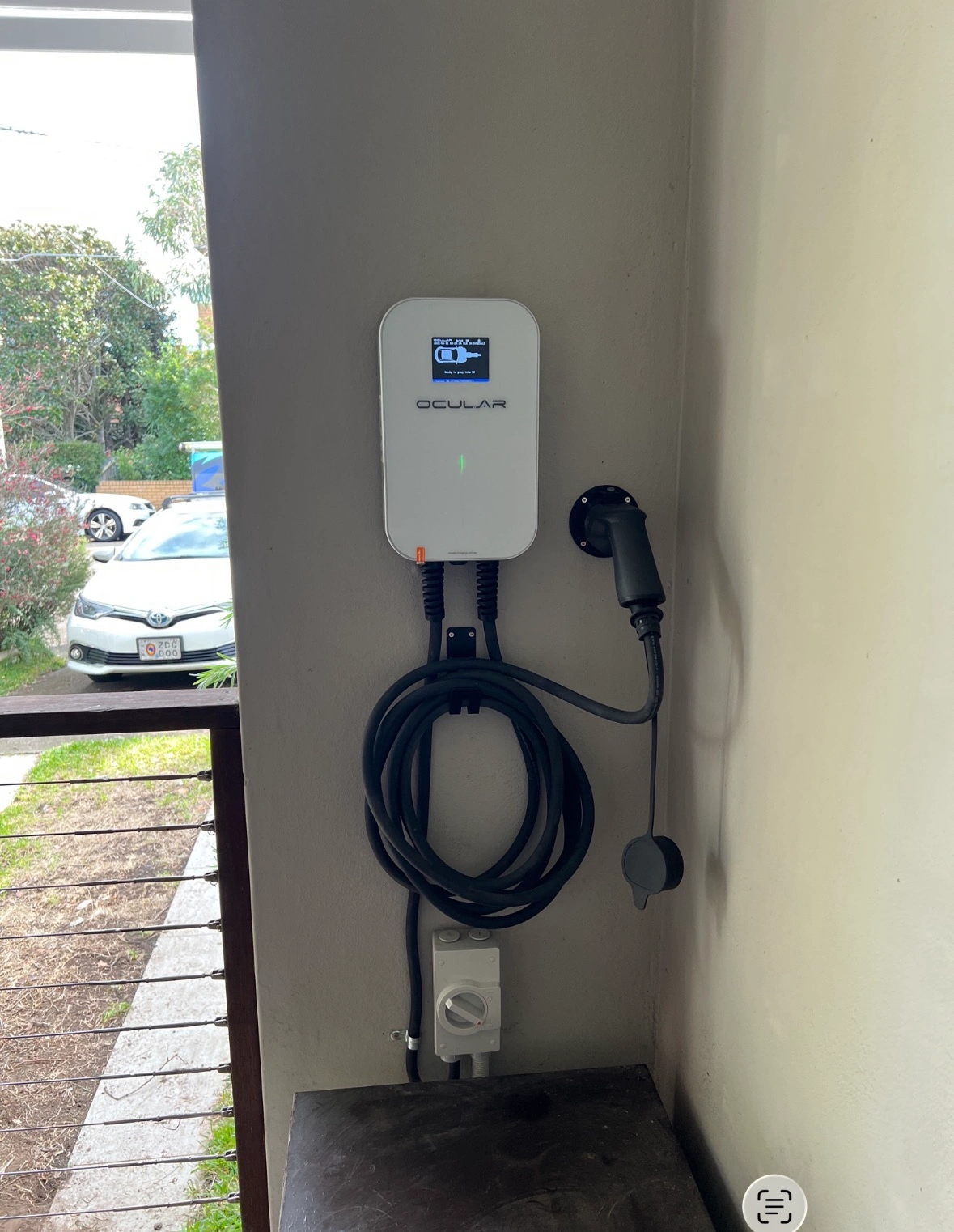
The charger is mounted at a height that lets the cable reach your charge port comfortably. Think about where your car sits and which side the port is on. If you chose a smart charger, the electrician can also help connect it to your Wi-Fi.
Testing and compliance
Installation is not finished when the unit is on the wall. A good finish includes these steps:
- Test the new circuit, including the safety switch, earthing and insulation
- Power on the charger and confirm it starts normally
- Run a test charge with your EV
- Label the switchboard and walk you through the controls, app and scheduling
- Lodge the Certificate of Compliance for Electrical Work (CCEW) and give you a copy
Keep your paperwork. The quote, compliance certificate and charger warranty are useful if you sell the home or need service later.
How long it takes
A straightforward install with a short cable run and enough capacity can often be done in a single visit. Jobs with long runs, trenching or a switchboard upgrade take longer. Your electrician can give you a realistic timeline after the site assessment.
Rules, standards and compliance in NSW
Compliance protects you, your home and your insurance cover. A licensed electrician handles most of this, but you should know what to expect.
What NSW requires
Installing a new circuit for an EV charger is electrical installation work, so it must be done by a licensed electrician. The electrician tests the work and lodges a Certificate of Compliance for Electrical Work (CCEW) with NSW Fair Trading. If the job also needs changes to the service, metering or supply, your network provider, such as Ausgrid or Endeavour Energy, may be involved.
Skipping compliance can create problems later:
- Your home insurer may question damage linked to non-compliant wiring
- A home sale can stall if an inspection finds uncertified work
- You may need to pay to have the work corrected
The Wiring Rules and continuous loads
An EV charger is not like a toaster or a kettle. It draws a high load for hours at a time, so the circuit protection, cable size and charger rating must all work together with a safety margin. The AS/NZS 3000 Wiring Rules set the requirements. The areas that matter most include:
- Circuit sizing: the breaker and cable must be rated for sustained draw, not just peak use
- Safety switch (RCD) protection: appropriate RCD protection for the charger circuit
- Earthing: a proper earth path protects you if a fault occurs
- Equipment: the charger should be suitable for its location and use
Outdoor and weather exposure
Many Sydney homeowners park in a carport or on the driveway. Rain and sun are part of the planning, so the equipment must be built for it.
| Component | Outdoor consideration |
|---|---|
| Charger unit | Choose a model with a suitable IP (weather) rating for outdoor use |
| Isolation and connections | Weatherproof enclosures that protect the connection |
| Cable and conduit | Outdoor-rated conduit, with trenching for detached spots |
| Mounting location | Clear of pooling water, splash zones and vehicle impact |
Mount the unit where the cable reaches your port without being stretched, dragged through puddles or left lying across the driveway.
How much EV charger installation costs
The total cost covers the charger and the electrical work. Where you land depends on your switchboard, the cable distance and the charger you pick, so a written, itemised quote is the only reliable figure.
The charger
- A portable charger often comes with the car and needs only a suitable power point
- A basic wall charger costs less than a smart model with solar and app features
- Pick the features you will actually use: a basic, outdoor-rated unit charges your car overnight just as well
Labour and materials
Labour depends on how hard it is to get power from the switchboard to your parking spot. Several factors push the price up or down:
- Distance between the switchboard and the charger location
- Whether cable passes through finished walls, the roof space or the subfloor
- Indoor garage mounting versus an exterior wall or carport
- The cable size required by the charger rating
Switchboard upgrades and trenching
These two items cause most of the jump from a low quote to a high one, and neither shows up on every job.
| Scenario | Cost pressure |
|---|---|
| Spare capacity, garage next to the switchboard | Lower end |
| Long cable run through finished spaces | Moderate increase |
| Switchboard upgrade needed | Large increase |
| Trenching to a detached spot | Large increase |
Some homes can avoid an upgrade. Your electrician may suggest a charger with adjustable current or load management, which keeps charging within your existing capacity.
Ways to lower the total
Government programs, energy retailer offers and EV tariffs come and go. Check the NSW Government energy website and your energy retailer for current offers before you buy, and confirm whether any program requires specific equipment or a licensed installer.
Book an EV charger assessment
We check your switchboard, capacity and cable route, then quote a charger installation that suits your car and your home.
Why you should hire a licensed electrician
A home EV charger is one of the heaviest electrical loads in your house. It runs for hours at a time, often overnight, and leaves little room for error. That is why a licensed electrician is essential, not an optional extra.
Safety and fire risk of DIY wiring
In NSW, fixed electrical wiring must be done by a licensed electrician. Mistakes can lead to serious risks:
- Fire hazards from overheated cables or loose connections
- Electric shock during installation or later use
- Costly damage to your EV and the charger
Sizing the circuit wrong, or adding it to a switchboard that cannot carry the load, creates problems you may not see until something fails.
Insurance, warranty and liability
Most charger manufacturers require professional installation for the warranty to stay valid. If a non-compliant installation causes damage, you want a contractor who carries insurance. Before you sign anything, ask for:
- A current NSW electrical contractor licence (you can check it through NSW Fair Trading)
- Proof of public liability insurance
- A detailed written quote that lists equipment, labour and compliance paperwork
- Direct experience installing EV chargers, not just general electrical work
Licensed electrician versus handyman at a glance
| Factor | Licensed electrician | General handyman |
|---|---|---|
| Licence | NSW electrical licence you can verify | Can't legally do fixed wiring |
| Capacity check | Assessed before work begins | Often skipped |
| Compliance | Meets the Wiring Rules, tested and certified (CCEW) | No compliance certificate |
| Insurance | Proof of insurance available | Varies, and may be absent |
| Warranty | Supports manufacturer coverage | Can put coverage at risk |
A non-compliant installation could create costly problems long after the job is finished.
Hire for the work that happens behind the wall, because that is the part you cannot easily inspect yourself. For more tips, read 5 things to know before hiring an electrician in Sydney.
Retailer-arranged install or independent electrician?
Many owners ask whether to use the installer arranged by the car dealer or charger retailer, or to hire their own electrician. Both routes can work. The right pick depends on your home, your budget and how much control you want.
Dealer and retailer packages usually connect you with a contracted installer. They can be convenient, but some offer a fixed "standard install" that doesn't cover longer cable runs or switchboard work, so check what is included.
| Factor | Retailer-arranged install | Independent electrician |
|---|---|---|
| Installer choice | Assigned by the retailer | You choose the licensed electrician |
| Charger options | Often limited to one brand | Any suitable charger |
| Scope | May be a fixed standard install | Quoted to your home and route |
| Scheduling | Depends on the program's demand | Set directly with the contractor |
| Quote comparison | Fewer quotes to weigh | You can compare several written quotes |
Questions to ask before hiring
Whoever you choose, check them the same way:
- Do you hold a current NSW electrical contractor licence, and can I check it?
- Can you show proof of insurance?
- Have you installed EV chargers before, and which models?
- Will you assess my switchboard and capacity before quoting?
- Does your written quote list the charger, labour, materials and any switchboard work?
- Will you test the work and give me a copy of the CCEW?
- Which charger and settings suit my car, my supply and my solar?
Clear, specific answers are a good sign. Vague replies or pressure to skip the paperwork are not.
The best installer is the one who can show a licence, show insurance, and explain every line of the quote.
FAQ
Can any electrician install an EV charger?
It must be a licensed electrician, ideally one with EV charger experience. Ask whether they have installed your charger model before.
Can I install a home EV charger myself?
No. In NSW, fixed electrical wiring, including a new circuit for a wall charger, must be done by a licensed electrician. You can use a portable charger on a suitable existing power point, but have the circuit checked if you plan to use it often.
What should I ask for when hiring an electrician?
- Their NSW contractor licence number
- Proof of insurance
- A capacity assessment of your switchboard and supply
- A written quote with line items
- A copy of the Certificate of Compliance (CCEW) when finished
How much does it cost to install a Tesla Wall Connector?
Costs follow the same factors as other home chargers: the unit, the cable distance and any switchboard work. A Tesla Wall Connector is hardwired, so it needs a dedicated circuit. Request a quote for a price based on your home.
Is a portable charger on a power point enough?
It works for light daily driving, but it charges slowly. A wall charger is the practical choice for most homes because it can refill a battery overnight.
Do I need a switchboard upgrade?
Not always. A capacity assessment decides it. If your switchboard has no spare space or capacity, an upgrade or load management may be needed before the charger goes in. See our switchboard upgrades.
Are there incentives?
Government programs, retailer offers and EV tariffs change over time. Check the NSW Government energy website and your energy retailer for current offers, and confirm any equipment or installer requirements before you buy.
Conclusion
A home EV charger is a long-term upgrade to your property. The quality of the install shapes how safely and reliably it performs for years.
Start with the basics: choose a suitable wall charger, confirm your switchboard has the capacity, and plan for a dedicated circuit. Those three decisions drive nearly everything else.
Your next steps
- Choose a charger based on your car, your driving and your parking spot.
- Have a licensed electrician assess your switchboard and capacity before you commit.
- Check the electrician's NSW licence and proof of insurance.
- Get a written quote that includes testing and the compliance certificate.
- Check current government and retailer offers before you buy.
Shortcuts save little and risk a lot. A tested, certified job protects your home, your car and your cover. Treat the installer as seriously as the charger, and you will plug in every night with confidence.
EV charger installation by Russo Electrical
Licensed Sydney electricians for home EV chargers, from the capacity check to testing and certification. See our EV charger installation service.
More from Russo Electrical
Official resources
- NSW Fair Trading (licences and compliance)
- NSW Government: Energy
- Standards Australia: AS/NZS 3000 Wiring Rules
- Ausgrid (electricity network)
Programs, offers and requirements can change. Check the official websites for current information.